Method Feeder Kits: What to Buy, What's Included and Which Suits Your Fishing
Clear guidance on what a method feeder kit includes, the three kit types, recommended products and how to choose feeder weights and moulds for UK commercial waters.
You want to fish the method feeder. You have seen the kits available, noticed that prices range from a fiver to well over a hundred pounds, and you are not entirely sure whether you need a full rod-and-reel combo or just a handful of feeders and a mould. That confusion is understandable, because the market lumps genuinely different things under the same label. This article separates the three distinct types of method feeder kit, names specific options at each level and gives a clear verdict on which suits your situation. All options covered are UK-stocked. If you want guidance on setting up the rig itself and fishing the method feeder effectively, the setup guide covers that in full.
What a method feeder kit actually contains
The phrase "method feeder kit" describes anything from a single feeder with a mould to a complete rod, reel and terminal tackle bundle. Before comparing products, it helps to know what the individual components are and why each one matters.
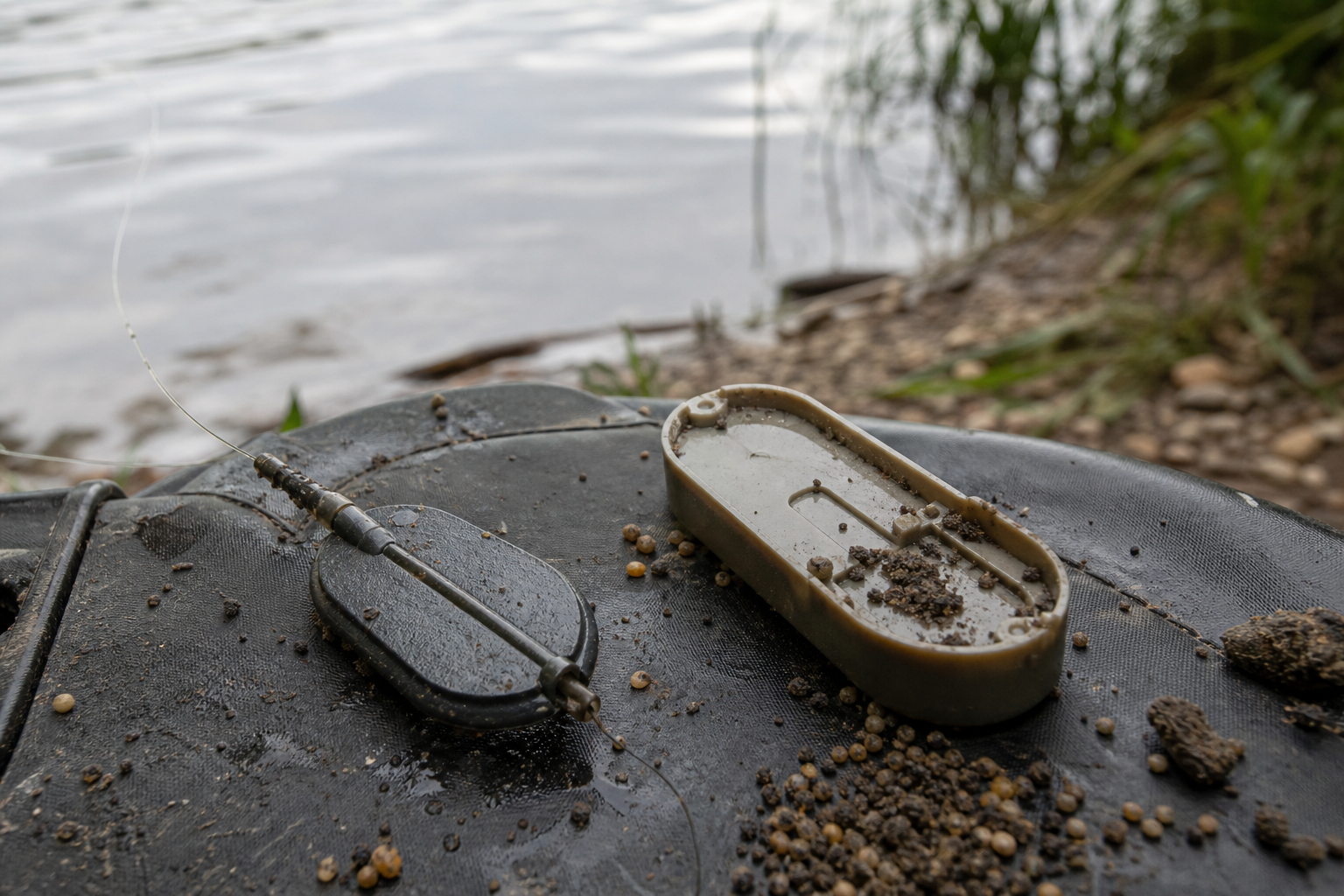
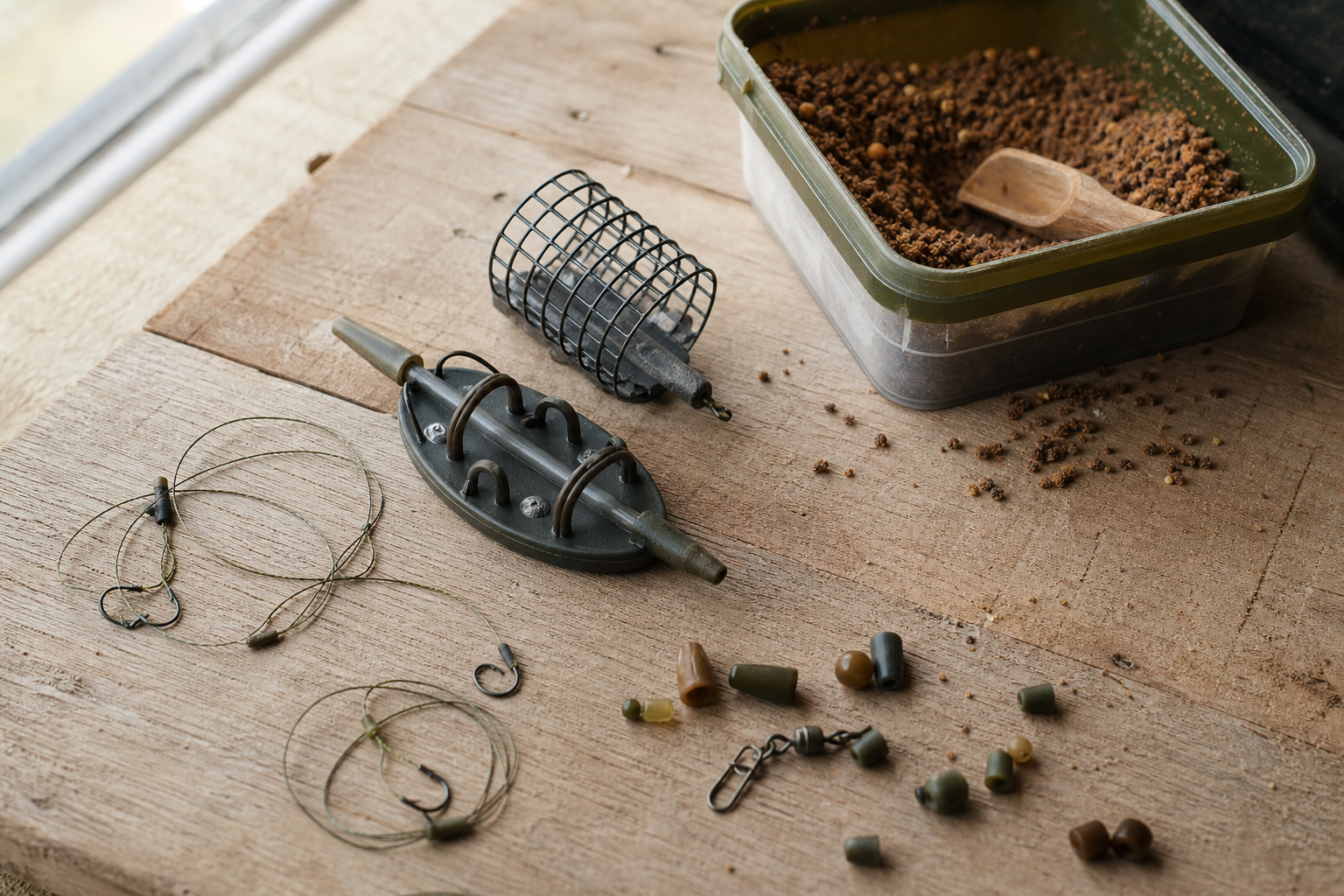
At the core of any method feeder setup is the feeder itself: a weighted plastic or rubber frame designed to hold a ball of groundbait or pellets around a short hooklength. The hook bait sits within or just below this ball, so that when the bait breaks down a carp finds the hook bait immediately. A mould is the tool that presses bait onto the feeder into a consistent, aerodynamic shape before each cast. Beyond those two items, a working setup needs a hooklength with a hair rig, bait band or bait spike, and a means of connecting the hooklength to the mainline quickly and cleanly.
A reasonably complete terminal kit will include most or all of the following:
- Flat inline method feeders in one to three weights (the useful UK range is roughly 20 g to 60 g)
- A matched method feeder mould, shaped to fit the specific feeder design
- Ready-tied hooklengths with hair rigs, bait bands or spikes
- Quick-change beads or speed beads and tail rubbers for connecting hooklengths to the mainline
- In more complete kits: a spool of mono mainline, scissors, a disgorger, a method mix or softened pellets
What the mould is for
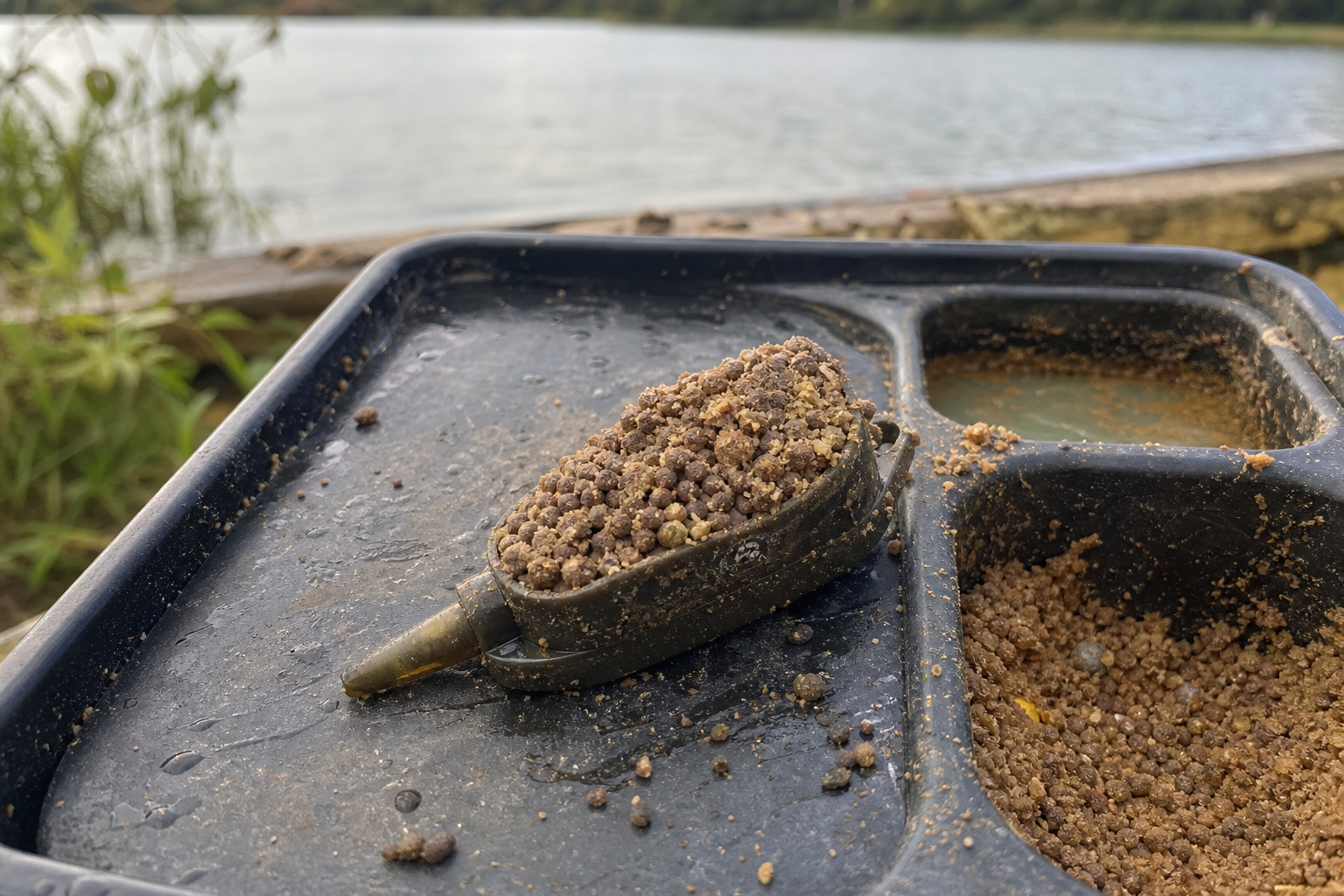
The mould compresses groundbait or pellets onto the feeder into a neat, consistent shape. Without one, hand-packed bait tends to fly off during the cast or release unevenly on the bottom. Every setup, however basic, needs a mould matched to the feeder.
The three types of method feeder kit
The market divides into three genuinely different purchase types. Comparing a feeder-and-mould pack with a full starter combo is like comparing a set of tyres with a complete car: the categories serve different starting points. Get clear on which category you need before looking at individual products.
Feeder-and-mould packs (terminal only, entry level)
These packs contain one or more feeders and a matched mould, and nothing else. Some include two or three feeder weights; others are sold as a single feeder with its dedicated mould as a pair. What they do not include: hooklengths, beads, line or any other terminal accessories. The assumption is that you already have a complete rig setup and simply want to add or replace feeders.
Typical price range: £5 to £15. These suit anglers who already have a rod, reel and terminal tackle and just need feeders and a mould, or who want to top up a weight they do not currently carry.
Terminal tackle kits (feeders, mould, hooklengths and accessories)
This is the most useful category for the returning angler. These kits go beyond feeders and a mould to include ready-tied hooklengths, quick-change beads, tail rubbers and sometimes a method mix or pellets. The components are chosen to work together, which removes the compatibility guesswork that comes with buying individually. What they do not include: a rod, reel or mainline. The assumption is that you already own workable gear on that front.
Typical price range: £20 to £60. These suit returning anglers who own a feeder rod and reel but whose terminal tackle is out of date or incomplete.
Full starter combos (rod, reel, line and terminal tackle)
Full combos bundle a rod, reel, spooled mainline and a selection of terminal tackle into a single purchase. They are designed for anglers who are starting completely from scratch, or whose existing gear is genuinely no longer fit for purpose. They are not the right choice for someone who already owns a working feeder rod and reel; buying a combo when you only need terminal tackle means paying for components you do not need.
Typical price range: £60 to £120. These suit anglers who own nothing suitable or who want to replace an entire setup in one go.
| Kit type | Typical contents | Price range | Best for |
|---|---|---|---|
| Feeder-and-mould pack | Feeders in 1–3 weights plus a matched mould | £5–£15 | Anglers with rod, reel and rigs already set up |
| Terminal tackle kit | Feeders, mould, hooklengths, beads, sometimes bait and tools | £20–£60 | Returning anglers who need the full terminal side but own a rod and reel |
| Full starter combo | Rod, reel, line, feeders, mould and hooklengths | £60–£120 | Anglers starting from scratch or replacing very old gear |
Feeder-and-mould packs worth considering
At the budget end, a few options stand out as sensible purchases rather than generic filler.
Decathlon method feeder and mould pack sits at the lower end of the price range and is widely available in-store and online. The feeders are straightforward flat method designs, the mould is functional, and the pack represents reasonable value for anyone who simply needs a feeder and something to shape the bait with. The design is not sophisticated, but it does the job on a commercial day-ticket water.
Drennan flat method feeder with matched mould is a proven match-fishing option. Drennan's feeder design has been used on UK commercials for years and the matched mould is purpose-made for that specific feeder shape, which matters more than it might seem. The mould produces a clean, consistent ball that holds through the cast and releases reliably on the bottom. Available individually or as a paired set, with weights typically ranging from 20 g to 45 g. If mould compatibility is your priority (and it should be), this pairing is worth the modest extra cost over a generic set.
4+1-style multi-feeder packs (four feeders plus a mould, sold under various brand names) are commonly available from tackle retailers and online marketplaces. Quality varies. The useful ones offer two or three different weights in the same pack, which covers most scenarios at a commercial fishery without buying multiple sets. Check that the included mould is designed for the feeder shape in the pack; some cheaper bundles include a mould that does not match properly.
These packs are a sensible top-up purchase or a budget starting point for the terminal side. They are not a complete solution: without hooklengths and beads, you will still need to source the rest of your rig components separately.
Terminal tackle kits for returning anglers
If you are returning to the method feeder, this is where you will find the most useful options. A good terminal kit removes the need to research and source every component individually, and the best ones are genuinely cheaper than buying the equivalent items separately.
Fish With Carl Simple Method Feeder Kit is the lead recommendation at this level. Carl's kits are designed with the returning and weekend angler in mind: components are matched, ready-tied hooklengths are included, and the instructions make the setup process straightforward without being patronising. The kit includes six 24 g method feeders, two moulds, two packs of ready-tied hooklengths, speed beads and 1,000 m of 8 lb mainline, plus 1 kg each of method mix and method pellets. The price at the time of writing is £60, which is fair for what you receive. The main limitation is that bait choice is fixed because the method mix is included; you cannot tailor the groundbait to your specific water.
YOTO-style multi-weight inline feeder packs offer a lower-cost alternative for the feeder and mould side. These packs typically include five or more feeders across a range of weights (commonly 20 g, 30 g, 40 g and 50 g) alongside a mould. They are sold by various suppliers under similar branding and the quality is generally adequate for commercial stillwater use. The gap is that they rarely include hooklengths or beads, so you will need to source those separately. Paired with a packet of ready-tied hooklengths and a set of quick-change beads, the total cost is typically still below the mid-range complete kits, making this a reasonable route for budget-conscious anglers who do not mind two separate purchases.
Buying a terminal tackle kit vs. piecing it together
Strengths
- + Components are matched and ready to use without compatibility research
- + Ready-tied hooklengths remove the need to tie modern carp rigs
- + Often cheaper than buying the same items individually
- + Bundled instructions and bait lower the barrier for returning anglers
Limitations
- - You may receive feeders or accessories you rarely use
- - Bait choice is fixed in some kits; you cannot tailor the mix
- - Terminal kits assume you already own a suitable rod and reel
Full starter combos: when a rod-and-reel set makes sense
A full method feeder starter kit makes sense in a narrow set of circumstances: you own no suitable rod and reel, or the gear you have is genuinely not up to feeder fishing (a light float rod from the 1990s, for example, is unlikely to cast a loaded method feeder cleanly or handle the strike reliably). If that describes your situation, a complete combo is a reasonable investment.
The Ultimate Method Feeder Set from Fishdeal is one of the more commonly referenced complete combos in the UK at this price point. At the time of writing it is available in the £60 to £90 range depending on the retailer. It typically bundles a purpose-built method feeder rod (3 m, about 10 feet, rated for casting weights up to 50 g), a matching reel pre-spooled with mono or braid, and a selection of feeders with a mould. Some versions include hooklengths. The components are entry-level, which is honest rather than a criticism: at this price point, a complete outfit that works on a commercial day-ticket water is the realistic expectation, not high-end match components.
What a full combo does not do is replace a genuinely good existing rod and reel. If you have a 10 or 11-foot feeder rod from a reputable brand that is still in good condition, it is almost certainly adequate for commercial stillwater method feeder work. Do not buy a full combo simply because your gear is old. A 15-year-old Drennan or Browning feeder rod paired with a decent fixed-spool reel is still a functional setup; spend your money on the terminal tackle instead.
Choosing the right feeder weights for your water
The weight of the feeder is the buying decision that most directly affects whether your kit is useful at your specific venue. Get this wrong and you are either under-casting on a larger pool or using unnecessary weight on a small commercial lake.
| Feeder weight | Typical use | Notes |
|---|---|---|
| 20–30 g | Short-range fishing, most commercial lakes, calm conditions | Good starting weight; suits the majority of day-ticket venues |
| 40–50 g | Medium-range casts, larger pools, light wind | Useful second weight to own alongside lighter feeders |
| 55–60 g+ | Long-range work, strong crosswind, big reservoirs | Less commonly needed; only buy if your venue requires it |
For the majority of day-ticket commercial carp lakes in England and Wales, a 20 g to 30 g feeder covers most situations. These waters are typically compact, pegged close to features, and do not require long casts. A 40 g to 50 g feeder becomes useful on larger pools, on windier days when a lighter feeder drifts during the cast, or at venues where the nearest productive zone is further out than a short-range lake offers.
Heavier feeders of 55 g and above are less commonly needed on the kind of waters most returning and weekend anglers fish. Do not buy them speculatively; check what distance you realistically need at your venue first.
Multi-weight packs (whether standalone or as part of a terminal kit) are worth prioritising precisely because they remove this guesswork. Having a 20 g, 30 g and 40 g feeder in your bag means you can adjust on the bank rather than being locked into one option.
Inline feeders, quick-change beads and mould compatibility
There are a few configuration choices that matter when buying any method feeder kit, and understanding them prevents you from ending up with components that do not work together.
Inline is the standard modern recommendation. On an inline feeder, the mainline runs through the centre of the feeder body, which produces a direct, self-hooking effect when a fish picks up the bait and moves off. For commercial stillwater carp fishing, this is the most reliable and straightforward design to use. Some older kits and budget packs include feeders with a loop or attachment arm instead; these work, but inline is the configuration that most UK commercials and most rig components are designed around.
Quick-change beads (sometimes called speed beads) are the connector between the mainline and the hooklength loop. The bead clips onto a swivel or link at the end of the hooklength so that you can swap a tired or damaged hooklength for a fresh one in seconds without re-tying anything. This matters on a busy session when carp are feeding actively. Any terminal kit worth buying at the £20-plus level should include these; if yours does not, a packet costs less than £3 from any tackle retailer.
Mould compatibility is not optional. The mould must match the feeder's specific shape. A flat feeder designed for one mould will not produce a clean, even bait pack in a mould designed for a different profile. The bait either overhangs the edges or fails to compress evenly, which affects both casting and presentation on the bottom. Purpose-made moulds such as the Drennan matched mould or Fox's Flexi moulds are shaped precisely for their corresponding feeders. If a kit includes a mould, check that it is specifically paired with the included feeder design rather than a generic alternative.
Hybrid feeders combine a method feeder body with a cage or open-frame section. They are worth knowing about as a natural next step once you are comfortable with the standard method setup, but they are not a first purchase. Start with a straightforward flat inline feeder and the matched mould.
What to check before you buy
Before committing to any kit, four questions will quickly filter the right option for your situation.
Four questions before buying a method feeder kit
Do you already own a rod and reel?
If yes, a feeder-and-mould pack or terminal kit is enough. If not, or if your gear is very old, a full starter combo makes more sense.
What feeder weights does your venue need?
Check the typical casting distance at your water before choosing a kit. Short-range lakes need 20–30 g; bigger venues need heavier options.
Does the kit include hooklengths and beads?
If not, budget for ready-tied hooklengths and a packet of quick-change beads separately. These are not expensive but they are essential.
Does the mould match the feeder?
If buying separately, check that the mould is designed for your specific feeder shape. A mismatched mould produces inconsistent bait packing and poor casting.
A brief practical note before you head to your first session: check the rules at your chosen fishery before fishing. Some commercial waters restrict certain feeder types or require barbless hooks. Rules vary between venues, so a quick call or check of the fishery's website is worth the two minutes it takes.
If you are fishing in England or Wales, you will also need a valid Environment Agency rod licence before you cast. This applies regardless of the type of fishing or the venue; day and annual licences are available through the government website. Scotland and Northern Ireland have separate licensing arrangements.
Frequently asked questions
What does a method feeder kit include?
A method feeder kit can range from a single feeder and matched mould to a full rod, reel, spooled line and terminal tackle bundle. Typical terminal kits include feeders, a mould, ready-tied hooklengths, quick-change beads and tail rubbers.
Which kit should I buy if I already own a rod and reel?
If you have a suitable rod and reel, buy a feeder-and-mould pack to top up weights or a terminal tackle kit if you need ready-tied hooklengths and connectors. Only buy a full combo if you lack any suitable rod or reel.
What feeder weights should I carry for UK commercial waters?
For most day-ticket carp lakes a 20 g to 30 g feeder is the best starting point. Add a 40 g to 50 g for medium range or windy days. Buy 55 g plus only if your venue requires long range or heavy wind work.
Why must the mould match the feeder?
A matched mould compresses bait into the feeder's specific shape. A mismatched mould creates uneven packs that may fly off on the cast or release poorly on the bottom, harming presentation and casting performance.
Are quick-change beads and ready-tied hooklengths essential?
They are highly recommended. Quick-change beads let you swap hooklengths quickly during a busy session and ready-tied modern rigs save time and ensure effective hooking. If your kit does not include them, they are inexpensive additions.

Lake & Lines Editorial Team
Editorial team
The Lake & Lines editorial team brings together freshwater fishing guides and researched tackle advice, helping beginners and returning anglers prepare for better days by the water.