Pellets, groundbait and hookbaits for method feeder fishing
Step-by-step method feeder bait advice. Learn pellet dampening, when to use groundbait or a blend, hookbait positioning and the venue checks that save a session.
At a Glance
- Preparation matters more than brand; texture controls performance.
- Use the squeeze test and allow pellets to stand for the right time before packing.
- Pick pellets, groundbait or a blend based on water temperature and fish activity.
- Load the hookbait first and keep it central for consistent presentation.
- Check venue and regional rules to avoid banned baits and wasted sessions.
Getting your method feeder bait prepared correctly is the part of the session that most anglers rush, and it is usually where things start to go wrong. You have the feeder, you have the mould, but the pellets are either falling off on the cast or arriving in the swim in a solid lump that never breaks down. This article covers how to prepare pellets to the right texture, how to choose between pellets and groundbait depending on conditions, how to select and position a hookbait, and the venue rules worth checking before you leave home. If you are still getting the rig together, our method feeder setup guide covers rigs and assembly.
Why bait preparation matters more than bait choice
It is tempting to spend time choosing between pellet flavours and groundbait brands when the more important variable is preparation. A well-chosen bait mixed to the wrong consistency will underperform a simple, unfussy bait that has been prepared carefully. The pellet squeeze test, the water-to-groundbait ratio and the standing time all affect how your bait behaves on the cast, on the bottom and as it releases around the feeder. Get those right and you are already fishing effectively.
This matters practically because it shifts the question from "which bait should I buy?" to "how do I prepare what I have?" That is a more manageable problem, and one you can solve at the waterside with what is already in front of you.
The sections below start with pellets because they are the standard method feeder bait on most commercial stillwaters, then move to groundbait, hookbaits and the rules worth knowing before you arrive.
Preparing pellets for the method feeder
Which pellets to use
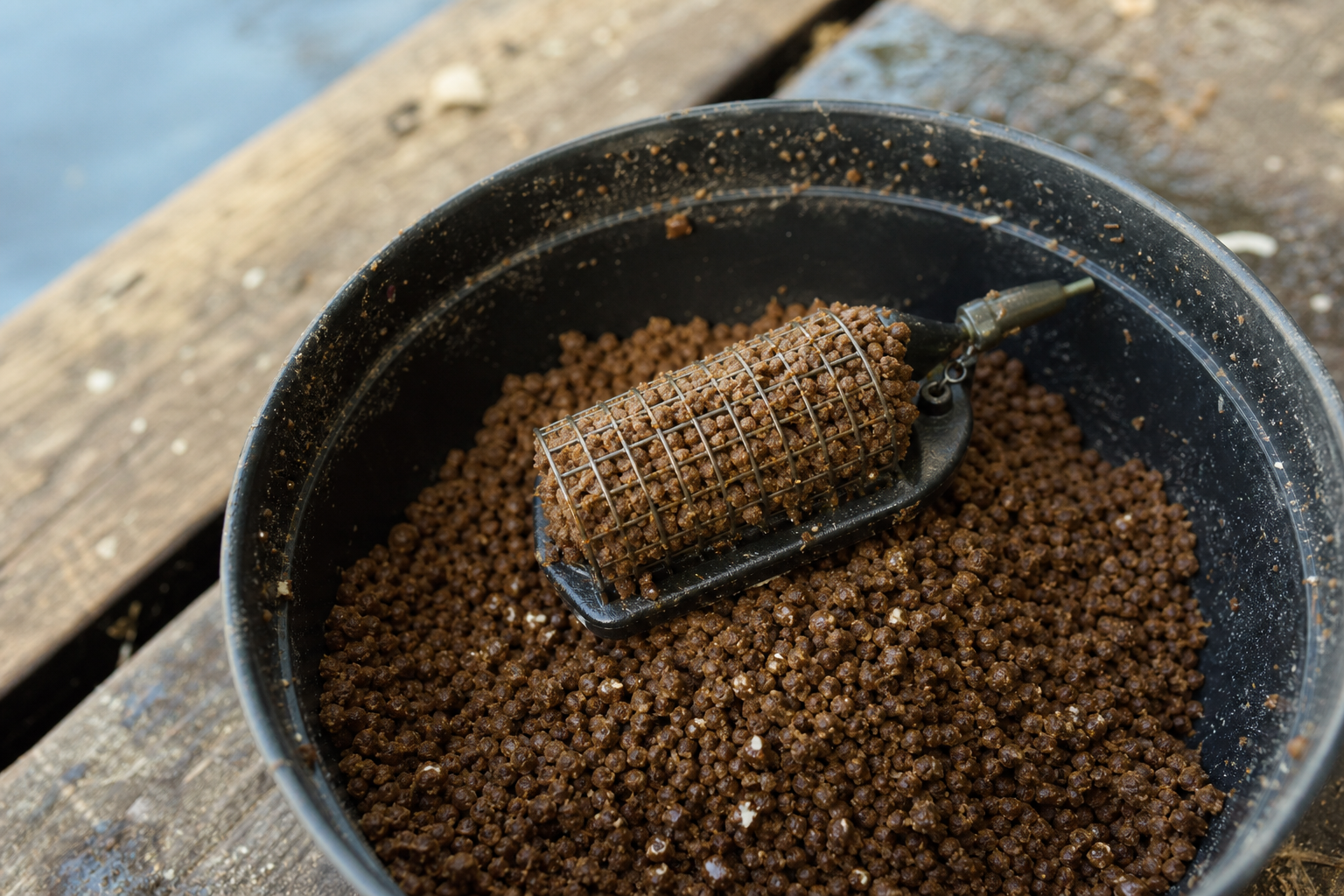
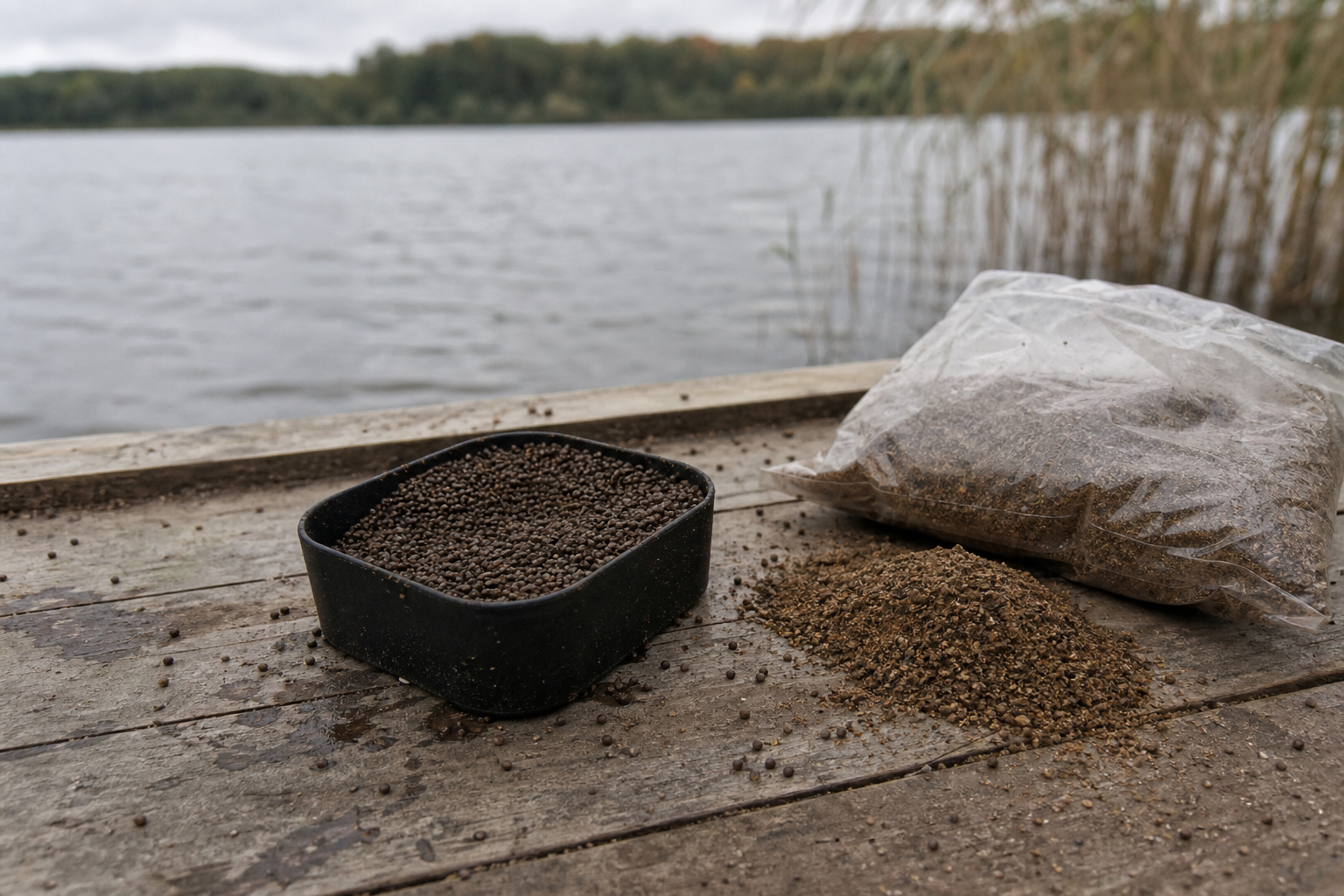
2 mm micro pellets are the standard for packing onto the feeder body. They compress well in the mould, create a particle-rich release cloud as they break down on the bottom, and hold their shape during the cast when dampened correctly. Most commercial fisheries either sell them on site or permit them without restriction. A fishmeal or halibut-based micro is a reliable starting point; different waters respond differently to different base ingredients, so it is worth experimenting across sessions rather than treating one flavour as universally superior.
1 mm pellets are worth knowing about for colder water conditions, when a faster breakdown can help draw fish that are feeding slowly and less actively. They are less commonly needed but useful to have if the session calls for a quicker attraction plume.
3 mm pellets work well as a variation on slower days or when you want a slightly coarser presentation. They hold together a little longer on the bottom before releasing, which can suit fish that are picking carefully rather than competing for food.
Ready-to-use method pellets, sold pre-dampened or treated to absorb water quickly, are now available from most tackle shops. They can be a practical option when you want to reduce waterside preparation time, though many anglers prefer the control that comes with dampening pellets themselves.
How to dampen pellets correctly
This is where most anglers go wrong, and it is almost always a matter of adding too much water too quickly. The process below works consistently with standard 2 mm micro pellets.
Preparing 2 mm micro pellets for the feeder
Measure out your pellets
Put enough for roughly an hour's fishing into a bait tub. You can always prepare more.
Add water gradually
Pour just enough water to barely cover the pellets. Do not soak them in a full tub of water.
Wait and drain
Leave for 60 to 90 seconds, then drain any excess water and spread the pellets loosely to stand.
Check the texture
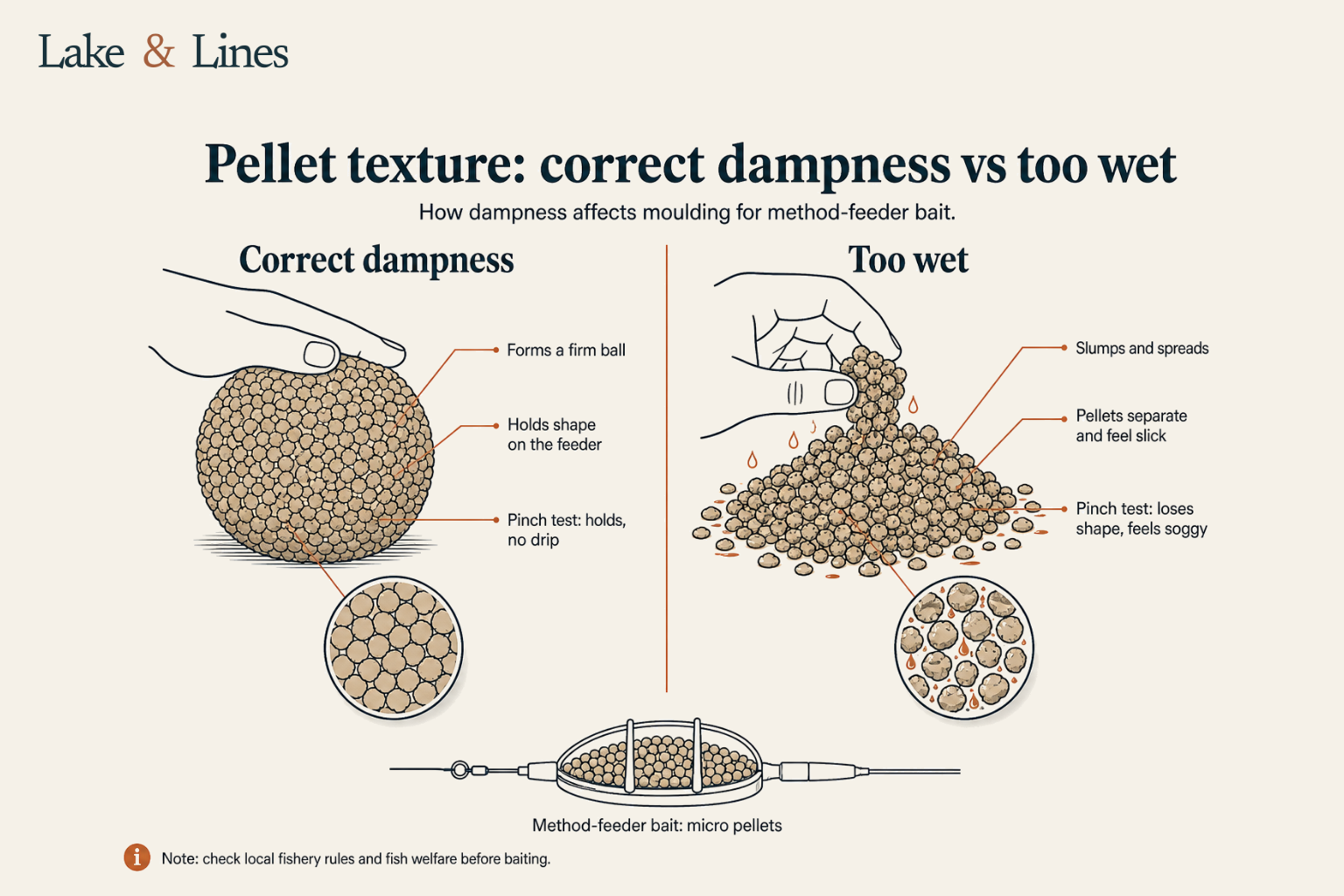
After two to three minutes, squeeze a small handful. They should form a firm ball that holds its shape but crumbles when pressed again. If they are slimy or paste-like, they are too wet.
Adjust if needed
Too dry: add a very small splash of water and mix through. Too wet: spread them out and leave for a further five minutes.
Standing time varies between pellet brands and changes with temperature. Cold weather slows the absorption process noticeably; a pellet that takes two minutes to reach the right texture in summer may need four or five in winter. Hot weather can dry the surface quickly while the centre stays hard. Rather than relying on a fixed timer, test a squeeze on arrival and adjust from there.
The squeeze test
A good feeder pellet should form a ball when you close your fist around it, then break apart cleanly when you press it against your palm. If it slumps or smears, it is too wet. If it crumbles immediately without holding shape, it needs another minute or two to soften through.
Groundbait for the method feeder, and when to use it
What makes a good method mix groundbait
Method mix groundbait is designed to do something slightly different from the groundbait you would use in an open-end or cage feeder. It needs to be stiff enough to mould firmly around the feeder body and hold its shape during the cast, but soft enough to release from the bottom once it settles. A mix that is too soft will break apart in the air; a mix that is too stiff will sit on the bottom intact and release nothing.
Fishmeal-based method mixes are the usual choice on commercial carp and F1 waters. They bind well, attract fish through both scent and particle content, and are widely available at fishery shops. Add water in small increments and give the mix time to absorb fully before testing the consistency. Method groundbait needs more water than many anglers expect at first, but it absorbs slowly, so adding too much too quickly is easy to do. Aim for a texture that holds a firm ball when squeezed hard but crumbles with a little pressure rather than remaining solid.
When to choose pellets, groundbait or a blend
The choice between pellets, groundbait and a blend of both depends mainly on water temperature, fish activity and how familiar you are with the peg. There is no single correct answer for every session.
| Situation | Recommended mix | Why |
|---|---|---|
| Warm water, lots of fish in the peg | 2 mm micro pellets only | Holds tight, withstands fish activity, releases steadily |
| Cooler water or fewer fish present | Method groundbait or groundbait-led blend | Wider attraction plume draws fish from further out |
| Deep peg or fish sitting high in the water | Groundbait-and-pellet blend | Lighter particles create attraction at different depths |
| First cast on an unfamiliar venue | 50/50 pellet and groundbait blend | Hedges between tight and wide attraction until you know the peg |
| Venue restricts certain pellets | Method groundbait only | Check fishery rules before you arrive |
Starting with a 50/50 blend on an unknown peg is a sensible hedge. It gives you some of the tight, particle-rich release that pellets provide alongside the wider scent plume that groundbait creates. Once you have a sense of how the peg is fishing, you can adjust the balance in either direction. The table above is a guide to decisions, not a formula to follow rigidly.
Choosing and positioning your hookbait
Standard hookbait choices for commercial stillwaters
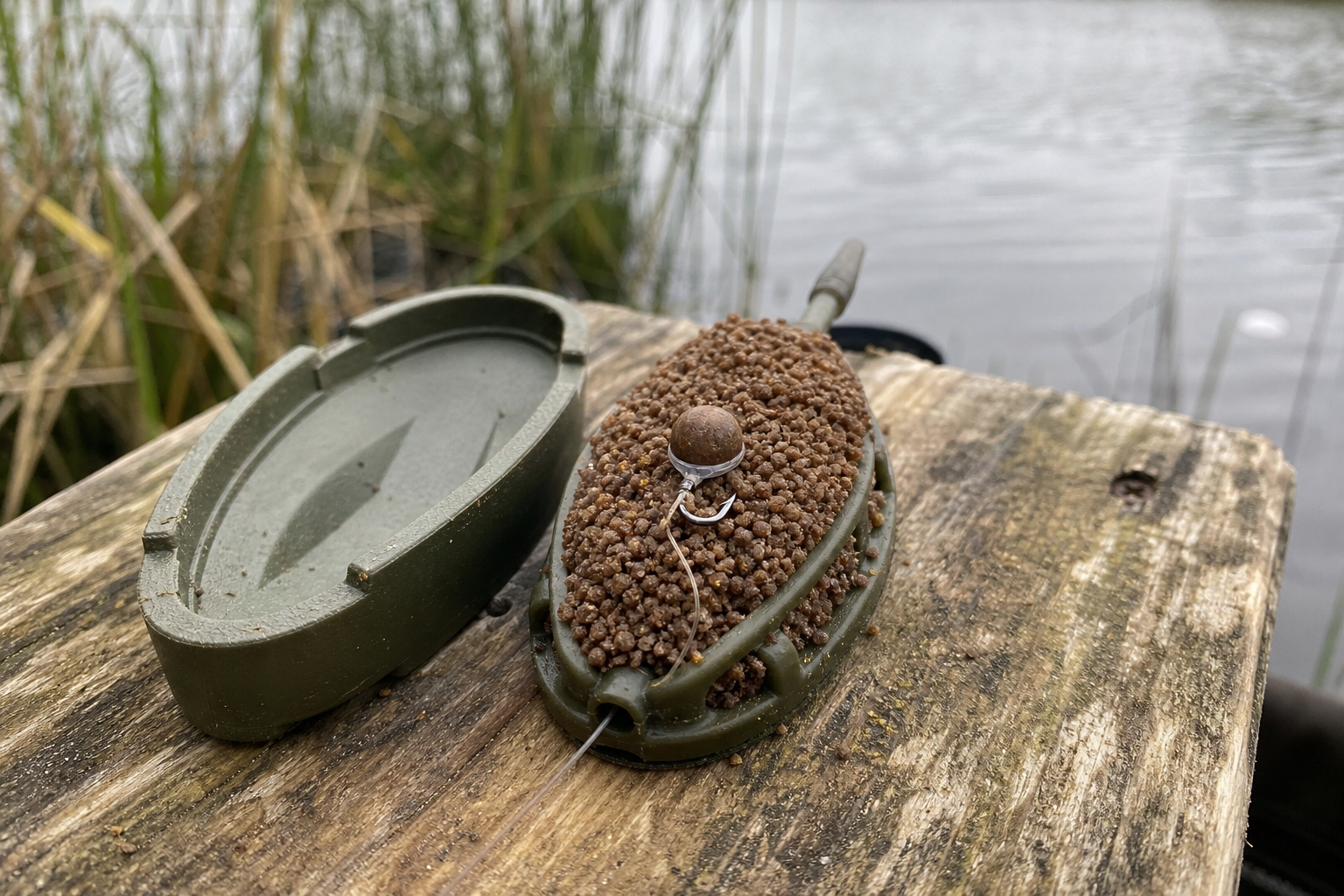
The method feeder hookbait needs to stand out from the loose feed releasing around the feeder. A 6 or 8 mm hookbait presented against a bed of 2 mm micro pellets gives the fish a clear target to single out from the cloud of smaller particles. Size matters here more than flavour.
Banded hard pellet (6 or 8 mm) is the most widely used hookbait on commercial carp waters. It is durable enough to survive multiple casts without needing to be replaced, easy to re-band quickly between takes and visible against a bed of micro pellets. Most anglers start here and adjust only if bites are not coming.
Soft expander pellet (6 mm) is a softer alternative that can be mounted on a fine band or a hair rig. It is more fragile than a hard pellet and will need replacing more frequently, but many anglers find it produces better bites from fish that have become cautious around hard hookbaits. It is worth carrying a few even if you do not start with them.
Corn, artificial or real, is a useful change bait if the fishery permits it and fish have seen a lot of pellet. Artificial corn is particularly practical because it does not come off the hook during casting. Check venue rules before using real corn, as some fisheries restrict or ban it.
How to load the hookbait into the mould
Positioning the hookbait in the mould is as important as choosing it. A hookbait buried too deep in the pellet ball will not present cleanly on the bottom, and one pushed off-centre can cause the hooklink to tangle in the ball during the cast.
Loading the mould correctly
Place the hookbait first
Drop your banded or haired hookbait into the mould before you add any pellets. This keeps it central and avoids burying it too deep or pushing it off-centre.
Fill the mould with dampened pellets
Pack the pellets in firmly, filling the mould completely. Press them down to remove air pockets.
Press the feeder in firmly
Push the method feeder into the packed mould with steady, even pressure. Do not twist or rock it.
Eject and check
Lift the feeder clear. The pellet ball should be tight, evenly shaped and free of obvious cracks. The hookbait should sit just below or at the surface of the ball.
Cast smoothly
A smooth overhead cast keeps the ball intact. A jabbing or rushed cast will throw the pellets off before they reach the water.
Consistency in mould loading builds a pattern. The same hookbait position, the same pellet density and the same cast means the feeder settles in the same way each time, building a small feed area that fish can find and return to. This matters more across a session than any individual bait choice.
Venue rules, national regulations and bait restrictions
Bait rules operate at two separate levels, and it is worth understanding the difference before you arrive at a fishery.
In England, freshwater fishing is governed by the Environment Agency's national rod fishing byelaws alongside regional byelaws, while in Wales the angling byelaws are set by Natural Resources Wales. These byelaws vary by area. Some Midlands byelaws, for example, restrict the use of bloodworms and jokers on certain rivers and drains in specific circumstances. This is unlikely to affect a session on a commercial stillwater, but it is relevant if you fish rivers or drains within those byelaw areas. The key point is that national rules and regional byelaws are not uniform across England and Wales: what applies in one area may not apply in another.
Scotland and Northern Ireland operate under separate regulatory frameworks. This article focuses on England and Wales. If you fish in Scotland or Northern Ireland, check the relevant national guidance for those jurisdictions separately.
Fishery rules sit on top of national law and are entirely separate from it. Commercial fisheries set their own bait restrictions, and these vary considerably between venues. Common restrictions include bans on tiger nuts and other nuts, limits on high-oil pellets, requirements to use only pellets purchased on site and occasional restrictions on flavoured or coloured baits. These rules exist for a range of reasons, including fish welfare and water quality, and they are enforceable by the fishery.
Check before you travel
Most commercial fisheries publish their bait rules on their website or at the gate. If the rules are not clear, ring the fishery. A five-minute call saves a wasted session if you arrive with bait that is not permitted.
Troubleshooting common method feeder bait problems
| Problem | Likely cause | Fix |
|---|---|---|
| Pellets fall off the feeder during the cast | Too dry, or cast too hard | Add a small splash of water and mix through. Use a smoother, slower cast |
| Pellet ball arrives at the swim intact but does not release | Too wet, compressed too tightly, or pellets are very cold | Use drier pellets or mix in a small amount of groundbait to loosen the structure |
| Bites drop off despite fish visible in the swim | Hookbait buried too deep or hooklink tangled in ball | Place hookbait centrally in the mould, not at the base. Check hooklink is free before casting |
| No bites at all on pellets | Fish not responding to particle feed | Switch to groundbait or a blend; consider a different hookbait such as corn or a wafter |
| Groundbait breaks up on the cast | Mix too dry or not left to absorb water fully | Add water gradually and leave mix to stand for five minutes before testing. Re-mix before casting |
Waterside adjustments are a normal part of fishing the method feeder effectively. If something is not working after four or five casts, it is reasonable to change the mix consistency, try a different hookbait or adjust the mould loading before concluding that the fish are simply not there. The troubleshooting table above covers the most common failure modes. Most of them have a straightforward fix that takes less than a minute.
The three things that make the most practical difference across a session are preparing bait to the right texture before the first cast, making a considered choice between pellets and groundbait based on conditions rather than habit, and knowing the fishery's rules before you leave home. Get those right and the rest of the session is about reading the water and adjusting as you go. If you are reviewing your feeder options alongside your bait choices, our guide to method feeder kits covers the key choices.
Frequently asked questions
What pellet size should I use for method feeder bait?
2 mm micro pellets are the standard for most commercial stillwaters. Use 1 mm in very cold water for faster breakdown and 3 mm when you want a slower, coarser release.
How do I know when pellets are dampened correctly?
Use the squeeze test. Pellets should form a firm ball that holds shape but crumble when pressed against your palm. Slimy or paste-like pellets are too wet; crumbly pellets need more standing time.
When should I use groundbait instead of pellets?
Choose groundbait or a groundbait-led blend in cooler water, when fish are less active, or to create a wider attraction plume. Pellets work best when fish are active and close to the peg.
Where should the hookbait sit in the mould?
Place the hookbait in the mould first so it sits central and just below or at the surface of the pellet ball. This prevents tangles and ensures a clear, visible target for fish.
How do I avoid bait being rejected at the fishery?
Check the fishery rules before you travel. Many venues publish bait restrictions online or at the gate. If unsure, call the fishery to confirm what is allowed.

Lake & Lines Editorial Team
Editorial team
The Lake & Lines editorial team brings together freshwater fishing guides and researched tackle advice, helping beginners and returning anglers prepare for better days by the water.