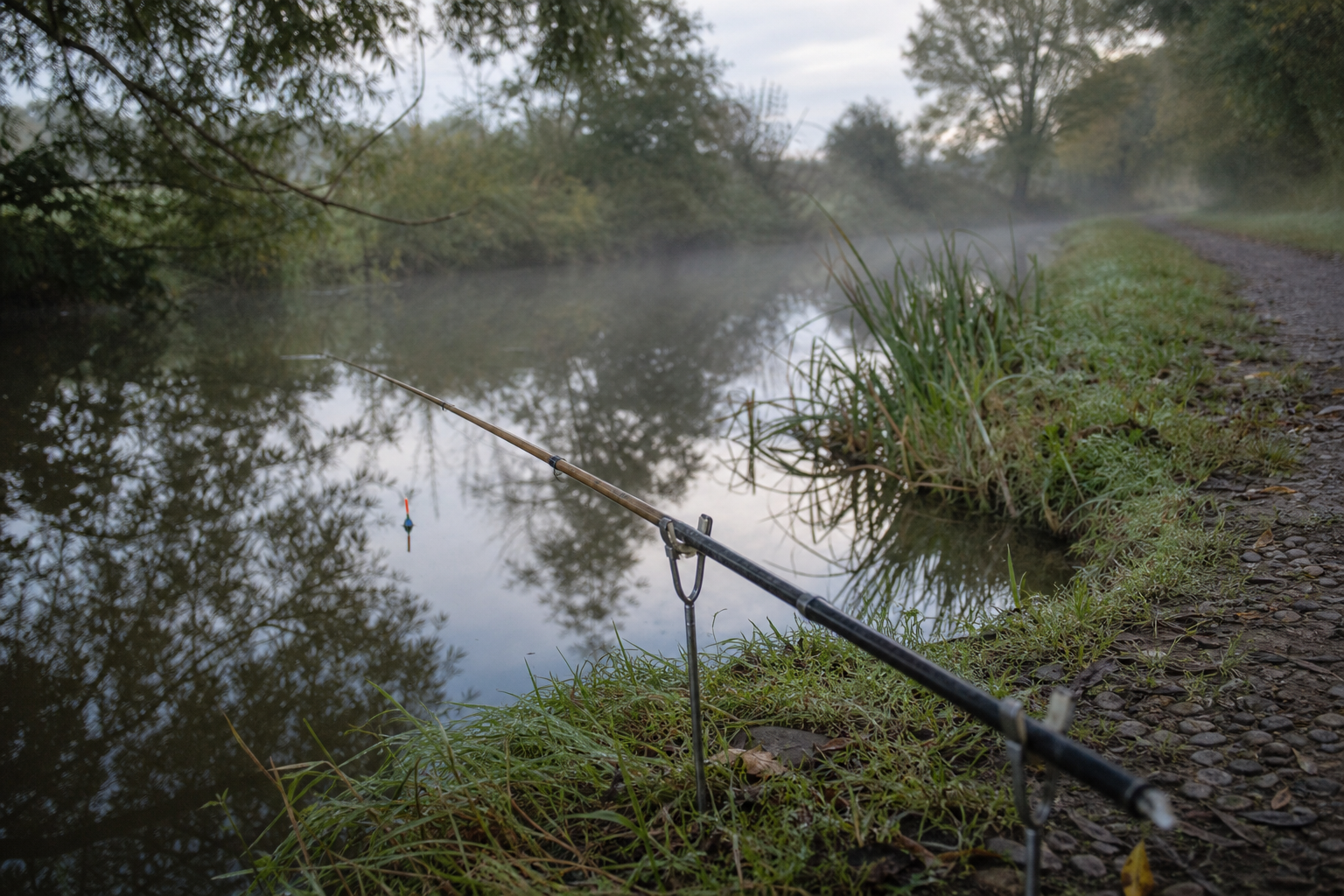
Canal Fishing for Beginners: Permits, Tactics and What to Expect on Your First Session
A practical primer on canal fishing for beginners: what licences and permits you need, basic tackle and bait, simple tactics and what to expect on your first session.
At a Glance
- Check and buy an Environment Agency rod licence and get permission for your chosen stretch via a local club ticket or CRT Waterway Wanderers. Use the CRT fishery list before you go.
- Start with simple tackle: 10–11 ft light float rod, small reel, 3–4 lb line, slim float, hooks 18–22 and maggots. Groundbait is optional.
- Plumb the near shelf, track and far shelf to find depth. The far shelf is often most productive for roach and perch.
- Feed small amounts of maggots regularly and be patient for 20–30 minutes while the swim builds. Re-feed after each fish and adjust depth if bites slow.
- Expect steady sport with small roach, perch and gudgeon. Learn to handle passing boats and re‑plumb after disturbance.
You have spotted a canal near you, perhaps a stretch of towpath you walk past regularly, and you are wondering whether you could fish it. The answer is almost certainly yes, and canal fishing for beginners is one of the most practical ways into coarse fishing in the UK. Canals are close to towns, easy to walk along, and full of fish that are well-suited to simple tackle and straightforward tactics.
Before you set up a rod, there are two things you need to sort out: the right permissions and a basic understanding of how a canal session works. This article covers both. By the end, you will know what paperwork you need, how to get it, what to bring, and how to spend your first few hours on the bank.
Why Canals Are a Good Place to Start
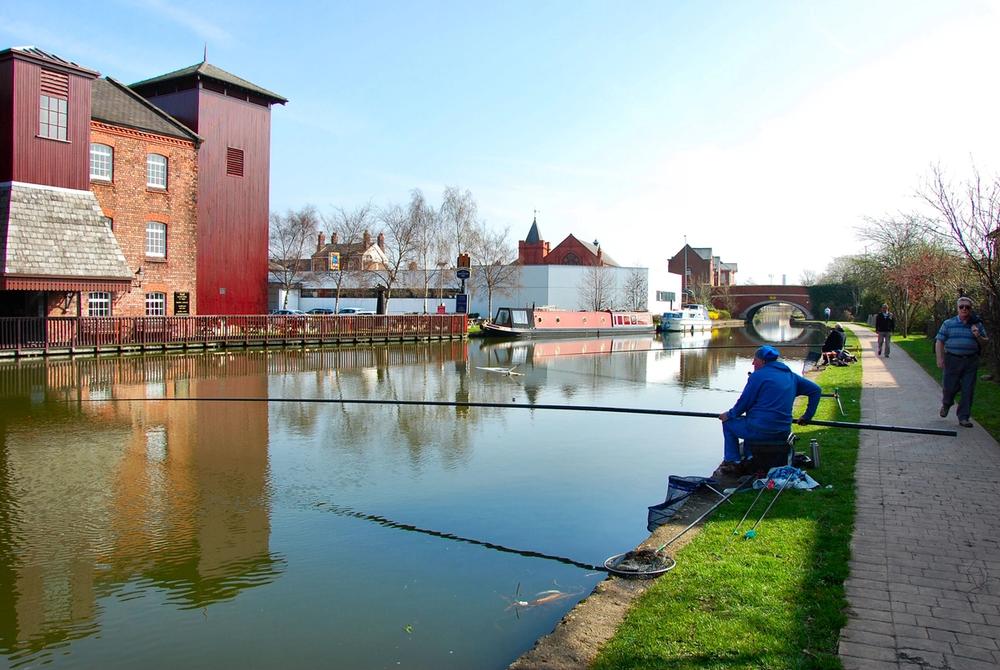
Canals are narrow, relatively shallow and consistent in character. Most are built to a similar cross-section, which makes them easier to understand than a river or a large lake. The towpath gives you a firm, flat place to stand, the water is usually within comfortable casting distance, and access is generally straightforward from public paths.
The species you are most likely to encounter are roach, perch, gudgeon and skimmers (small bream). These are not large fish, but they are active, reasonably obliging and rewarding to catch. Perch in particular are often willing biters in canals, and they will take a bait presented at almost any depth.
Canals also suit a beginner's budget. You do not need specialist gear or large quantities of bait. A simple float fishing setup, a bag of maggots and a reasonable approach to finding the fish will get you started on almost any canal in England and Wales.
Getting the Right Permissions for Canal Fishing
This is the part that causes the most confusion, and it is worth being clear about it from the outset. To fish legally on a canal in England and Wales, you need two separate things: a rod licence and permission to fish a specific stretch of water. One does not replace the other.
Your EA Rod Licence
A rod licence is issued by the Environment Agency and is a legal requirement for anyone aged 13 or over who fishes for freshwater fish in England and Wales. You buy it online through GOV.UK, and it covers you to fish anywhere you have lawful permission to fish.
Licences are available as short-term (1-day or 8-day) options or as a full 12-month licence. Check current prices on GOV.UK before purchasing, as fees are reviewed periodically. Junior licences for anglers aged 13 to 16 are free but must still be obtained. Under-13s do not need a rod licence, though a permit for the stretch (covered below) is still required.
If you fish in Scotland or Northern Ireland, the rod licence system works differently. Scotland has no rod licence requirement for coarse fishing; Northern Ireland operates its own permit system through the Loughs Agency and the Department of Agriculture, Environment and Rural Affairs. Check the rules for your specific location before you fish.
EA enforcement officers do check canals, particularly on popular stretches. A rod licence is a genuine legal requirement, not an optional formality.
Your Canal Fishing Permit
The rod licence gives you the right to fish; it does not give you permission to fish a particular place. That permission comes from whoever controls the fishing rights on that stretch of water.
On canals managed by the Canal and River Trust (CRT), which covers around 2,000 miles of canals and navigable rivers in England and Wales, the fishing rights on any given stretch are either leased to a local angling club or retained by CRT itself. This means there are two main routes to the permit you need:
- A local angling club ticket. Many clubs rent the fishing rights for specific stretches from CRT and sell day tickets or annual memberships to fish them. Day tickets are often affordable and available on the bank or in advance online. An annual club membership typically gives you access to multiple stretches and is worth considering if you plan to fish regularly.
- A CRT Waterway Wanderers permit. Where a stretch has not been leased to a club, CRT offers its own 12-month individual permit called Waterway Wanderers. This covers all CRT-managed unleased stretches across the network and is purchased directly from CRT.
The practical question is: which applies to the stretch you want to fish? The answer is to use CRT's fishery list before you go. This online tool lets you search by location and shows whether a stretch is leased to a club (and which one) or covered by Waterway Wanderers. Do not assume, and do not turn up without checking. Fishing an unleased stretch on a club ticket, or assuming a stretch is covered by Wanderers when it has a club ticket, are both common mistakes that are easy to avoid.
Check before you go
The stretch of canal near you might be controlled by a local club, or it might fall under CRT's Waterway Wanderers scheme. Look up your chosen stretch on the CRT fishery list before you buy a permit, so you purchase the right one.
A Note on Children and Family Sessions
Under-13s can fish without a rod licence but must fish with adult supervision and still need a permit for the stretch. Anglers aged 13 to 16 need a free junior rod licence, which they can obtain through GOV.UK in the same way as an adult licence. The permit for the stretch applies regardless of age. Canal fishing is well-suited to a first family outing: the towpath is easy to manage with children, and small fish tend to oblige.
What You Need for a First Canal Fishing Session
Canal fishing does not require a large amount of tackle. The list below covers what you genuinely need for a first session and what can wait until you have a better sense of how you want to fish.
Rod, Reel and Line
A light float rod of around 10 to 11 feet is a practical starting point for a canal. It gives you enough reach to fish the far shelf (explained in the next section) without being unwieldy on a towpath. Pair it with a small fixed-spool reel loaded with 3 to 4 lb monofilament. This combination is light, easy to handle and suitable for the roach, perch and gudgeon you are most likely to catch.
If you already own a short whip (3 to 5 metres), that is also a workable option on a narrow canal. A standard rod and reel is perfectly viable, though, and more flexible if you are starting from scratch.
Terminal Tackle and Floats
Terminal tackle refers to the hooks, floats, weights and other components at the end of your line. For a canal session, you want:
- Small hooks, sizes 18 to 22, tied to a light hooklength of around 1 to 1.5 lb breaking strain. A hooklength is a short, finer length of line between your main line and the hook, which makes the presentation more natural and gives you a weak point that breaks before your main line if a hook snags.
- A small waggler or canal float designed for close to medium distances. Canal floats are typically slim and sensitive, designed to register the gentle bites of small fish in still water.
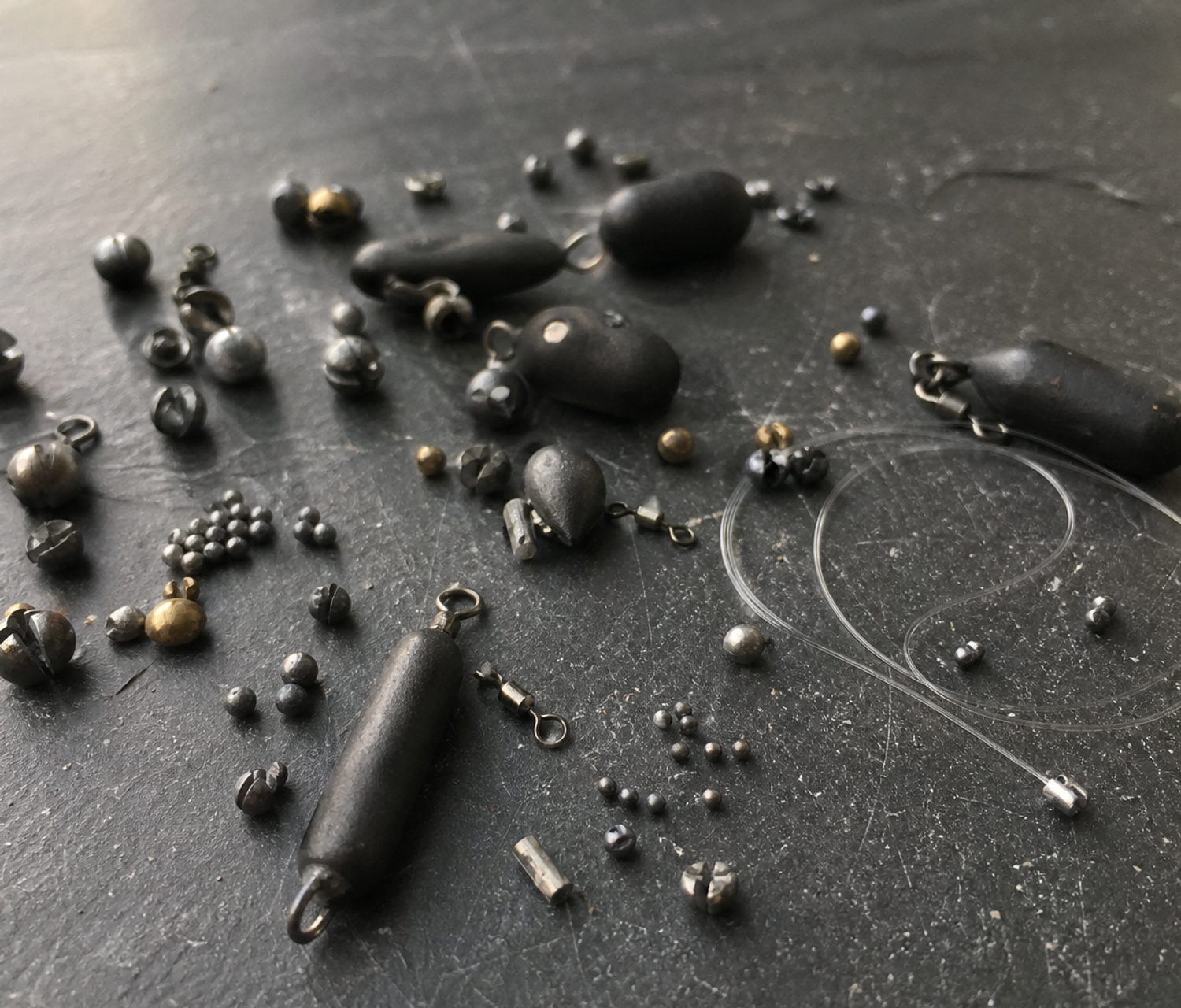
- Small split shot spaced down the line between float and hook. This style of shotting, sometimes called shirt-button shotting, allows the bait to fall slowly and naturally through the water, which often produces more bites than a heavy bulk of shot near the hook.
Bait
Maggots are the most reliable starting bait for a first canal session. They are available fresh from most tackle shops, easy to present on a small hook and attractive to virtually every species you will encounter on a canal. A single maggot on a size 20 hook is a perfectly good presentation; two maggots on an 18 give you a slightly larger offering if bites slow.
Dark groundbait, mixed to a fairly stiff consistency and introduced in small balls at the start of a session, can help draw fish into your swim. It is useful but not essential on a first outing.
Bread punch and worms are also worth knowing about as alternatives, particularly if roach are proving cautious or you want to target perch.
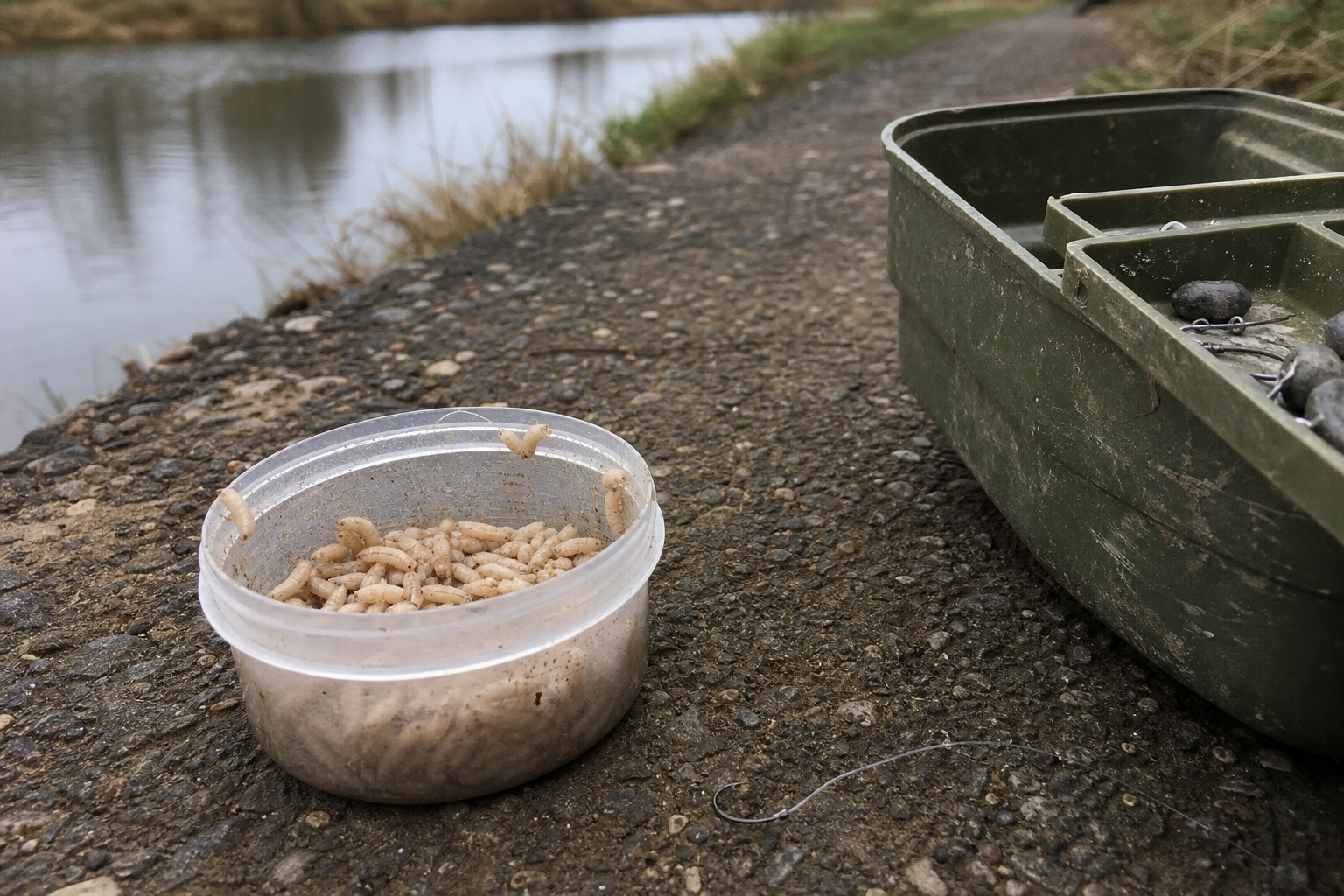
| Item | What to look for | Essential? |
|---|---|---|
| Float rod | 10–11 ft, light action | Yes |
| Fixed-spool reel | Small, balanced to the rod | Yes |
| Monofilament line | 3–4 lb breaking strain | Yes |
| Float | Small waggler or canal float | Yes |
| Hooks | Sizes 18–22, tied to light hooklength | Yes |
| Split shot | Small sizes, spaced down the line | Yes |
| Maggots | Fresh, from a local tackle shop | Yes |
| Groundbait | Dark mix, used sparingly | Optional |
Understanding Canal Features Before You Cast
A canal may look uniform from the bank, but it has a distinct cross-section that matters to how and where you fish. Understanding three zones will help you make sense of where the fish are likely to be.
The near shelf is the sloping margin directly in front of you. It is typically shallower than the rest of the canal and can hold fish close in, particularly perch and gudgeon.
The track is the deeper central channel where boats travel. It can be productive in cooler months when fish seek depth, though it is also the part of the canal most disrupted by passing boats.
The far shelf is the slope around a metre out from the opposite bank. This is often the most productive zone for patrolling roach and perch, particularly when the water is clear. Fish often patrol the far shelf looking for food that has fallen from the bank or towpath opposite.
Before you start fishing, take a few minutes to plumb the depth at each zone. Plumbing means using a small weighted clip called a plummet to measure the exact water depth at a given point. It is one of the most useful things you can do before your first cast, and it is simpler than it sounds.
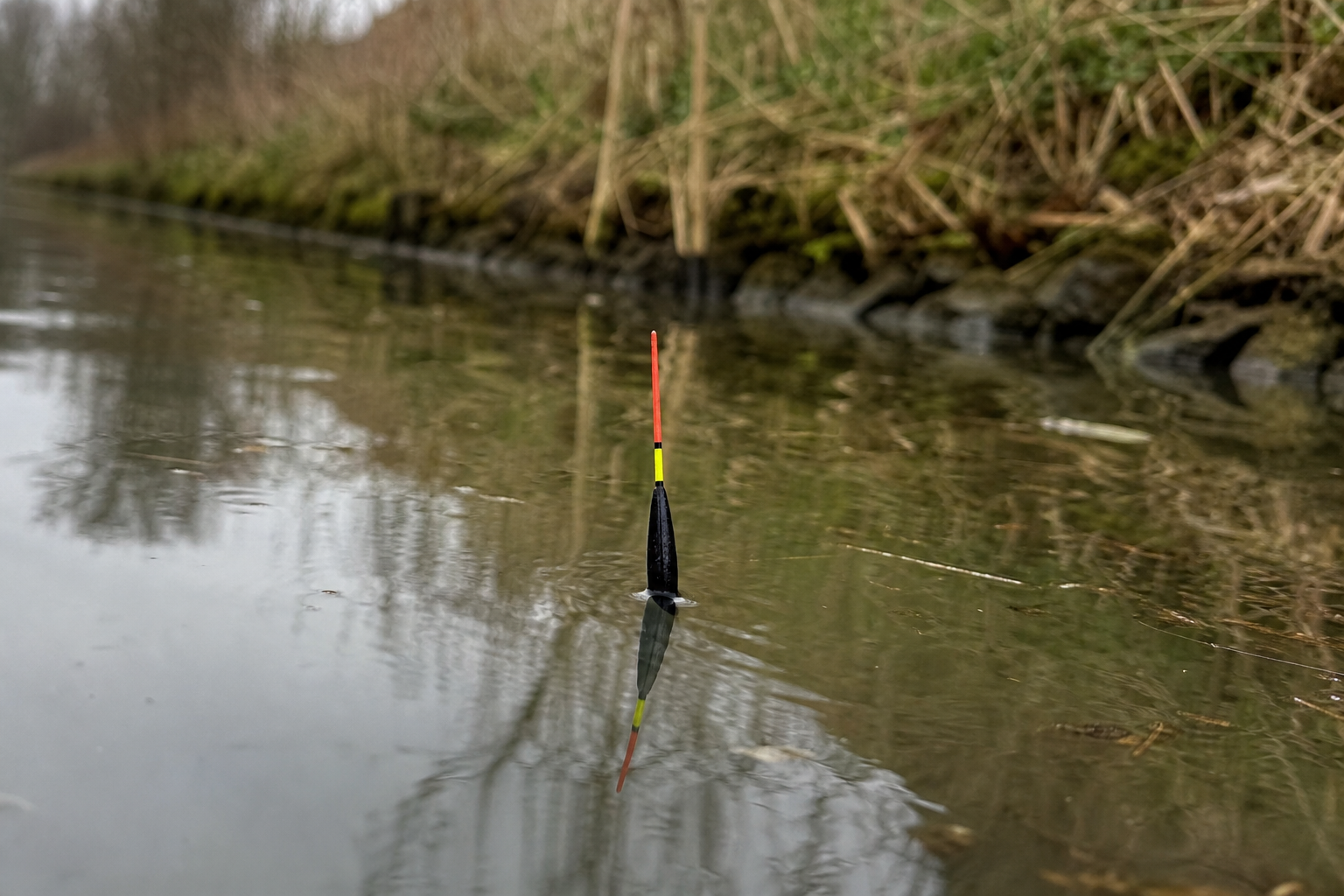
How to plumb the depth on a canal
Attach a plummet to your hook
Clip a small plummet onto the bend of the hook and push the hook point into the cork base to hold it in place.
Clip your float to the line
Attach your float and set it to what you estimate the depth might be. Start shallower than you think.
Lower the rig to the near shelf
Drop it in close to your feet and watch the float. If it lies flat, the float is set too deep and the plummet is resting on the bottom, so move the float down the line. If it disappears, the float is set too shallow, so move it up the line. Adjust until the float cocks upright with the tip just showing.
Repeat across the track and far shelf
Move your rig out in stages to build a picture of the canal's depth profile. Note which zone seems most fishable.
How to Fish a Canal: A Simple Session Plan
Here is how a practical first canal session might take shape, from arriving at the water to landing your first fish.
1. Walk before you set up. Spend five minutes walking a short section of the bank before you choose where to sit. You are looking for a peg (an established fishing spot on the bank) with a reasonable amount of depth in front of it, some cover on the opposite bank such as reeds, overhanging grass or a moored boat, and enough space above your head to cast without catching vegetation or bridge ironwork. Check for any club or CRT signage nearby confirming the stretch and any local rules.
2. Set up and plumb the depth. Assemble your rod, attach your reel and thread the line through the rings. Tie on your hooklength and hook, attach your float and add your split shot. Before you introduce any bait, plumb the three zones as described above. Most anglers targeting canal roach and perch fish the far shelf, but plumbing will tell you if the near shelf or the track offers a more workable depth.
3. Start the swim. If you are using groundbait, introduce one or two small, firm balls at the start of the session to your chosen feeding spot. The groundbait does not need to be large; a ball the size of a golf ball is enough. This creates a small area of interest on the bottom without overfeeding the swim. Then begin your loose feeding: a few maggots every minute or two, introduced accurately to the same spot.
4. Begin fishing. Cast or lower your float to your chosen line, at the depth you established when plumbing. Watch the float tip carefully. Canal bites from roach and perch can be subtle: a slight dip, a sideways movement or the float simply failing to settle properly. Strike gently by lifting the rod tip; you are not trying to drive a hook home hard, just tighten the line to connect with the fish. After landing each fish, wet your hands before handling it, hold it gently and return it carefully to the water.
5. Re-feed and repeat. After every fish, or every few casts without a bite, introduce a few more maggots to the same spot. Regular, accurate loose feeding is one of the most effective ways to keep fish competing in a small area in front of your float.
6. Adjust if bites slow. If the swim goes quiet, try shallowing the float by a few centimetres, which presents the bait higher in the water. You can also try a smaller hook, or move the float slightly to fish a different part of the swim. Small adjustments often restart bites that have stopped for no obvious reason.
7. Handling boat traffic. When a narrowboat or other craft approaches, lift your float clear of the water and hold the rod steady. Let the boat pass, allow a minute or two for the wash and disturbance to settle, then re-plumb your depth (passing boats can push water around and shift your float setting slightly), re-feed and start again. Boat traffic is a normal part of fishing a working canal. It disrupts a swim briefly but fish often return quickly once the water settles.
Feed little and often
On canals, small and regular feeding works better than large amounts introduced infrequently. Add five or ten maggots every minute or two rather than a large handful every quarter of an hour. This keeps fish searching and competing in a small area close to your float.
What to Expect on the Day
Canal fishing tends to produce small fish caught steadily rather than large individual specimens, particularly on a first session. Roach in the 2 to 4 ounce range, perch to perhaps half a pound, and gudgeon of any size are all realistic targets. That is not a limitation; it is simply the nature of the water. Building a rhythm, keeping the swim fed and catching a run of small fish is genuinely satisfying, and it develops the core skills that transfer to every other type of float fishing.
Boat traffic is a fact of canal fishing, not a problem to be alarmed by. On busy summer weekends, boats can pass every few minutes on some stretches. Early morning sessions, weekday visits and autumn or winter trips all tend to be quieter, with longer periods of undisturbed fishing.
Expect bites to take time to arrive, particularly at the start of a session. The swim needs building with loose feed before fish begin to visit regularly. Patience in the first 20 to 30 minutes usually pays off once the fish find the bait.
Cold weather, coloured water after heavy rain or water that is running through faster than usual can all reduce sport. These conditions do not make a session impossible but they do slow things down. If you choose a calm, mild day for your first outing, you are giving yourself the best possible chance of a steady session and a good first impression of canal fishing.
Frequently asked questions
Do I need a rod licence to fish a canal?
Yes. Anyone aged 13 or over fishing freshwater in England and Wales must have an Environment Agency rod licence bought via GOV.UK. Anglers 13–16 get a free junior licence. Under‑13s do not need a rod licence but still require permission to fish the stretch.
How do I get permission to fish a specific canal stretch?
Permission comes from whoever controls the fishing rights. Many stretches are leased to local angling clubs that sell day tickets or memberships. Unleased CRT stretches are covered by the Waterway Wanderers permit. Always check the Canal and River Trust fishery list before you go.
What tackle and bait are best for a first canal session?
Keep it simple: a 10–11 ft light float rod, a small fixed‑spool reel, 3–4 lb line, a slim canal float, small hooks (sizes 18–22) and maggots. Dark groundbait is optional but useful. This setup handles roach, perch and gudgeon well.
Where should I fish on a canal and how do I find the right depth?
Fish commonly use the near shelf, the central track and the far shelf. The far shelf is often most productive. Use a plummet to measure depth across these zones before you cast and set your float accordingly.
What should I expect on my first session?
Expect steady catches of small fish rather than big specimens. Boat traffic can disrupt a swim briefly. Feed little and often, be patient for the first 20–30 minutes while the swim builds, and adjust depth or hook size if bites slow.
Lake & Lines Editorial Team
Editorial team
The Lake & Lines editorial team brings together freshwater fishing guides and researched tackle advice, helping beginners and returning anglers prepare for better days by the water.