Choosing the Right Line for Coarse Fishing
Clear, practical guidance on selecting coarse fishing line. Learn when to use mono, braid or fluorocarbon, ideal diameters for float and feeder rigs, and how to check and dispose of old line.
At a Glance
- Treat diameter in millimetres as the key figure when comparing lines, not just breaking strain.
- Use floating or neutral monofilament for float work and sinking mono for feeder fishing.
- Reserve braid for long range feeder mainlines but always use a mono or fluorocarbon leader.
- Use fluorocarbon for hooklengths where low visibility and abrasion resistance matter.
- Check line before each session and recycle old line responsibly at collection points.
Standing in front of a wall of line spools at a tackle shop, or holding an old spool off your reel and wondering whether it still has any life in it, are both common starting points for the same question: which coarse fishing line do I actually need? The answer depends on more than breaking strain. Diameter, material and how a line behaves in the water all shape how well a rig presents, how cleanly it casts and how safely it handles a fish. This guide covers the three main material types (monofilament, braid and fluorocarbon) and how to choose between them for float and feeder setups on typical British waters. It does not cover knots, specialist carp rigs or sea angling; the focus is line selection for practical, everyday coarse fishing.
Why Diameter Matters as Much as Breaking Strain
Breaking strain is the number printed most prominently on a spool, but it tells you less than you might expect. The pound rating is a laboratory figure: it reflects the steady load a line can bear before breaking, measured under controlled conditions without knots, abrasion or the shock of a strike. In real fishing, knots alone can reduce breaking strain by 20 to 30 percent, and abrasion from gravel or snags weakens it further.
The more useful figure for comparing lines from different manufacturers is diameter, measured in millimetres. Two lines both labelled 6lb can differ by 0.05mm or more in diameter, and that difference affects everything: how the line casts through rod rings, how quickly it sinks, how much water resistance it creates in a current and how naturally a rig presents on the surface or bottom. When you are choosing between products, read both numbers on the label and treat diameter as your primary reference point.
Reading the spool label
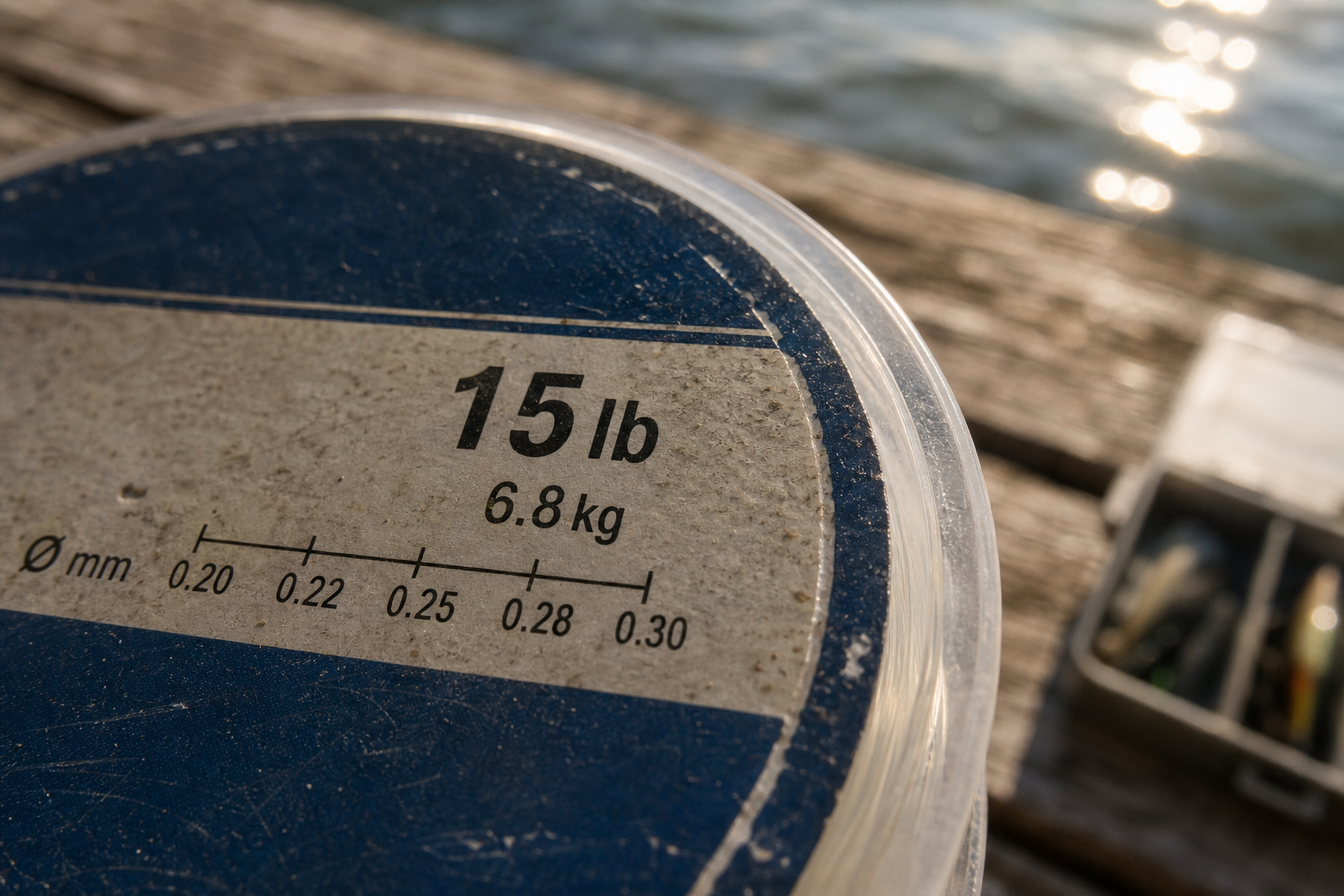
Most coarse fishing lines show both breaking strain in pounds and diameter in millimetres on the spool. If you are comparing two products, the diameter figure is the more useful one for understanding how a line will behave in use. Breaking strain alone does not tell you how the line casts, sinks or handles small hooks.
Monofilament, Braid and Fluorocarbon: Which to Use for Coarse Fishing
There are three main line materials available to the coarse angler. Each has a genuinely different character, and choosing between them is easier once you understand what each one is for.
Monofilament
Monofilament is the right starting point for almost all general coarse fishing, and it remains the dominant choice on UK stillwaters and rivers at every level. It stretches under load, which is a practical advantage: that cushion of stretch absorbs the shock of a hard strike, protects light hooks and reduces the chance of a fish bumping off during a spirited run. It knots easily, it is widely available across a broad price range and it handles reliably in cold weather.
The distinction worth knowing is between floating or neutral-buoyancy monos and dedicated sinking monos. Both are monofilament; the difference is in formulation and density. Floating and neutral-buoyancy monos stay at or near the surface and are the natural choice for float fishing, where you want the mainline to sit on the water rather than pulling a float off course. Sinking monos are formulated to sink readily and are marketed specifically for feeder and bottom fishing, where you want the line to lie flat on the lake bed between rod tip and feeder. The product label usually makes this distinction clear.
Braided line
Braid is a specialist tool, not a general upgrade over mono. Its two headline properties are a much smaller diameter for a given breaking strain (often 50 to 75 percent smaller than an equivalent mono) and zero stretch. In practice, that combination gives outstanding bite detection at long range, because there is no elastic to absorb the signal before it reaches the rod tip.
Those same properties also make braid less forgiving. There is no cushion on the strike, so knots must be tied carefully and reliably, and the line is hard on light hooks near netting. Most coarse anglers who fish braid use it as feeder mainline at longer distances, always combined with a mono or fluorocarbon leader between the braid and the feeder. That leader absorbs shock and makes the terminal end of the setup more manageable. Braid is not the right first-choice mainline for float fishing or for anyone setting up a general coarse outfit for the first time.
Fluorocarbon
Fluorocarbon's main role in coarse fishing is as hooklength and leader material, not as a mainline. It sinks readily (denser than mono), is very close to water in refractive index (making it harder for fish to see) and is more abrasion-resistant at the hook end than standard mono. Those properties make it a useful option in clear-water venues or on commercials where fish have seen a lot of tackle and have become cautious.
The reasons it is rarely used as a mainline are cost and stiffness. Fluorocarbon is significantly more expensive per metre than mono, and its stiffness makes it less pleasant to handle on larger spools. The sensible approach is a mono mainline combined with a fluorocarbon hooklength or leader where clarity and abrasion resistance matter.
| Material | Best use | Key advantage | Main limitation |
|---|---|---|---|
| Monofilament | Mainline for float and feeder | Forgiving, affordable, versatile | Higher diameter than braid at same strength |
| Braided line | Long-range feeder mainline | Very thin, excellent bite detection | No stretch, needs a leader, less forgiving |
| Fluorocarbon | Hooklengths and leaders | Low visibility, sinks well | Stiffer than mono, expensive for mainline use |
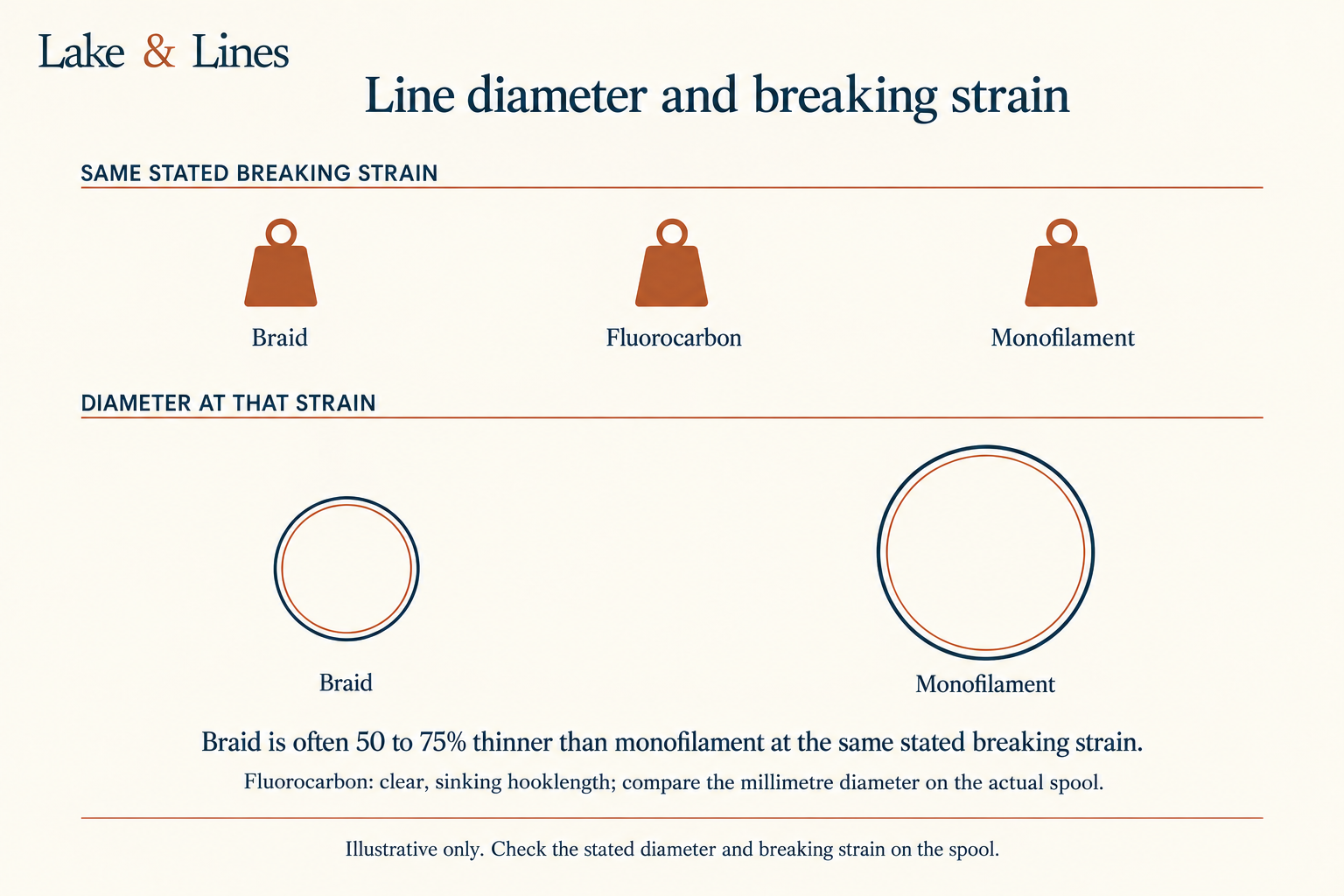
At the same stated breaking strain, braid is often 50 to 75 percent thinner than monofilament. The stated strain does not rise just because the material changes.
Line for Float Fishing
Float fishing places a premium on presentation, and that starts with the mainline. The right choice of coarse fishing line for float work keeps the rig balanced, makes casting lighter floats easier and reduces unwanted drag on the float from the line itself.
Mainline for float fishing
A floating or neutral-buoyancy mono is the standard choice for float fishing mainline. Keeping the line at or near the surface means it does not pull the float off-line or drag the bait away from where you want it. Lower diameters make a real difference here: a finer line passes through rod rings with less friction, which helps when casting light rigs at distance, and creates less surface resistance in a gentle drift or current.
The practical range most UK coarse anglers work within for float mainlines runs from around 1.5lb (roughly 0.12mm) for delicate canal or small-lake waggler work up to around 4 to 5lb (roughly 0.18mm) for river floats or swims where tench, bream or the occasional carp are a realistic prospect. Stepping up beyond that is sometimes necessary in snaggy swims or on venues with large carp, but accept that a heavier diameter will cost something in presentation.
| Situation | Suggested breaking strain | Approx. diameter | Notes |
|---|---|---|---|
| Delicate canal or small lake (roach, rudd) | 1.5–2lb | 0.12–0.14mm | Light floats, small hooks, fine presentation |
| General stillwater float (roach, bream, perch) | 2–3lb | 0.14–0.16mm | Good all-round starting point for most venues |
| River float or mixed bag with tench | 3–4lb | 0.16–0.18mm | Handles current and bonus fish without going heavy |
| Snaggy swims or carp likely on float | 5–8lb | 0.20–0.26mm | Accept some loss of presentation for fish safety |
Hooklengths for float fishing
The hooklength should typically be one to two steps lighter than the mainline. This is a practical safety principle: if something has to give under pressure, you want it to be the hooklength rather than the mainline rig, because losing a hook and a small length of line is far better than losing the whole float setup. A worked example: a 3lb mainline pairs naturally with a 1.5 to 2lb hooklength.
Hooklength material can be finer mono or fluorocarbon. Fluorocarbon is worth considering on clear-water venues or in situations where fish are inspecting the bait carefully before taking it. In most general situations, a finer mono hooklength is perfectly adequate. For a full breakdown of how these components fit together in a finished rig, the float fishing setup guide covers the assembly in detail.
Line for Feeder Fishing
Feeder fishing is harder on mainline than float fishing. The line contacts the bottom repeatedly, may drag over gravel, rock or silt, and takes the repeated load of casting a weighted feeder. Those demands shift the priority slightly: abrasion resistance becomes as important as breaking strain, and the right mainline needs to cope with both.
Mainline for feeder fishing
A dedicated sinking mono is the standard recommendation for feeder fishing mainline. These lines are formulated to sink readily and tend to be made with abrasion resistance in mind, which makes them more durable across a session of repeated casting and bottom contact.
The most common bracket for general UK feeder fishing is 4 to 8lb (roughly 0.18 to 0.24mm). This covers most cage feeders and straight leads up to around 2oz on natural and commercial stillwaters without using an unnecessarily heavy diameter. Method feeder fishing on commercials, where carp are a common and realistic catch, typically calls for something closer to 6 to 10lb to handle fish safely without sacrificing too much casting accuracy. At longer range or with heavier feeders, braid with a mono leader becomes worth considering.
| Situation | Suggested breaking strain | Approx. diameter | Notes |
|---|---|---|---|
| Light cage feeder, small silvers, close range | 4–6lb | 0.18–0.20mm | Fine enough for small hooks, handles most feeders to 1oz |
| General feeder for mixed coarse (bream, tench) | 6–8lb | 0.20–0.24mm | Good all-round bracket for commercial and natural venues |
| Method feeder on commercials, carp likely | 8–10lb | 0.24–0.28mm | Enough strength for carp, still manageable diameter |
| Long-range feeder or heavy feeders (2oz+) | 10–14lb mono or 15–20lb braid | 0.26–0.30mm | Consider braid with a leader for distance work |
Leaders and hooklengths for feeder fishing
When braid is used as feeder mainline, a leader is not optional. A length of 6 to 10lb mono or fluorocarbon tied between the braid and the feeder serves two purposes: it absorbs the shock of the cast and the strike, which braid cannot do on its own, and it protects the knot connection from abrasion on the bottom. A rod length is a common guide for leader length, giving enough material to sit comfortably on the spool during casting.
Feeder hooklengths follow the same logic as float hooklengths: lighter than the mainline and designed to be the weak link if something goes wrong. Fluorocarbon is a sensible choice for feeder hooklengths in clear water or cautious-fish situations, for the same reasons it works well in float fishing. For the full rig assembly, including how to attach feeders, tie hooklengths and set up a method feeder, the method feeder setup guide takes you through the process step by step.
Can You Use the Same Line for Float and Feeder?
This is a straightforward question that deserves a direct answer. Technically, yes: some modern sinking monos are marketed as suitable for both applications, and that is broadly true if your float fishing is not particularly delicate and your feeder fishing is at moderate range. A 5 to 6lb general mono can serve as a working compromise across both setups.
In practice, separate setups are better. A floating or neutral-buoyancy mono on the float rod and a dedicated sinking mono on the feeder rod gives you the right line behaviour for each method without compromise. If budget or storage makes it genuinely impractical to run two spools, the sensible bias is to err slightly heavier rather than lighter. Landing a fish promptly and safely on the feeder matters more than the marginal presentation improvement that a finer float mainline would offer. Going too light in both directions helps nobody, least of all the fish.
Checking, Replacing and Disposing of Line Responsibly
When to replace line
There is no fixed interval for replacing fishing line, but the check is easy and worth doing regularly. Pull the first few metres off the spool and run the line between your fingers. Kinks that will not straighten under light tension, flat spots, rough patches and any section that has taken a hard knock against a snag are all reasons to strip that section back and retie from fresh line. If the whole spool is heavily twisted, noticeably discoloured or has a long history of abrasion, replacing it entirely is the right call.
The fish welfare connection
Line condition and appropriate breaking strain are not separate from fish welfare: they are part of it. The Angling Trust's best-practice guidance makes clear that suitable tackle, including line that is matched to the likely catch and in good condition, is part of responsible angling. Line that is too light for the fish in the swim, or old line with compromised strength, extends the fight unnecessarily and increases the risk of harm to the fish. Matching your coarse fishing line to the venue and the species is not just about catching more effectively; it is about landing fish promptly and returning them safely.
In England, the Environment Agency's national byelaws do not set line strengths or require 'appropriate tackle' as such, but good-practice guidance and many fishery rules expect line that is matched to the fish you are likely to catch. Rules in Scotland, Wales and Northern Ireland differ from those in England and should be checked through the relevant country-specific authority.
Responsible disposal
Old line should never be left at the water's edge or dropped in the water. Discarded monofilament and braid can trap and injure wildlife, and it persists in the environment for a very long time. The Anglers National Line Recycling Scheme (ANLRS) operates collection points at many tackle shops and fisheries across the UK. Spooling off old line into a bag and dropping it at a collection point on your next visit to a shop is a simple habit that makes a real difference.
Checking your line before you fish
Pull the first few metres of mainline off the spool and run it between your fingers. If you feel any roughness, see flat spots or notice kinks that do not straighten under light tension, strip that section back and tie on again from fresh line. A few minutes at the start of a session is worth it.
Frequently asked questions
What matters more, breaking strain or diameter?
Diameter is usually more useful for predicting how a line will cast, sink and present a rig. Breaking strain is a lab value and omits knots, abrasion and shock. Read both but use the diameter as your primary reference.
Which coarse fishing line is best for float fishing?
A floating or neutral-buoyancy monofilament works best for float fishing. It keeps the mainline on the surface, aids presentation and handles light floats better than sinking options.
When should I use braid on a feeder rig?
Use braid for long range or heavy casting where a thinner diameter and high bite detection help. Always add a mono or fluorocarbon leader of 6 to 10lb to absorb shock and protect the knot.
Is fluorocarbon a good mainline for coarse fishing?
Fluorocarbon is best used for hooklengths and leaders because it sinks and is less visible. It is stiffer and more expensive than mono, so it is not usually practical as a mainline.
How do I know when to replace my line?
Pull a few metres off the spool and run it between your fingers. Replace or strip back the section if you feel kinks that do not straighten, rough patches, flat spots or obvious abrasion. Replace the spool if damage is widespread.
Lake & Lines Editorial Team
Editorial team
The Lake & Lines editorial team brings together freshwater fishing guides and researched tackle advice, helping beginners and returning anglers prepare for better days by the water.