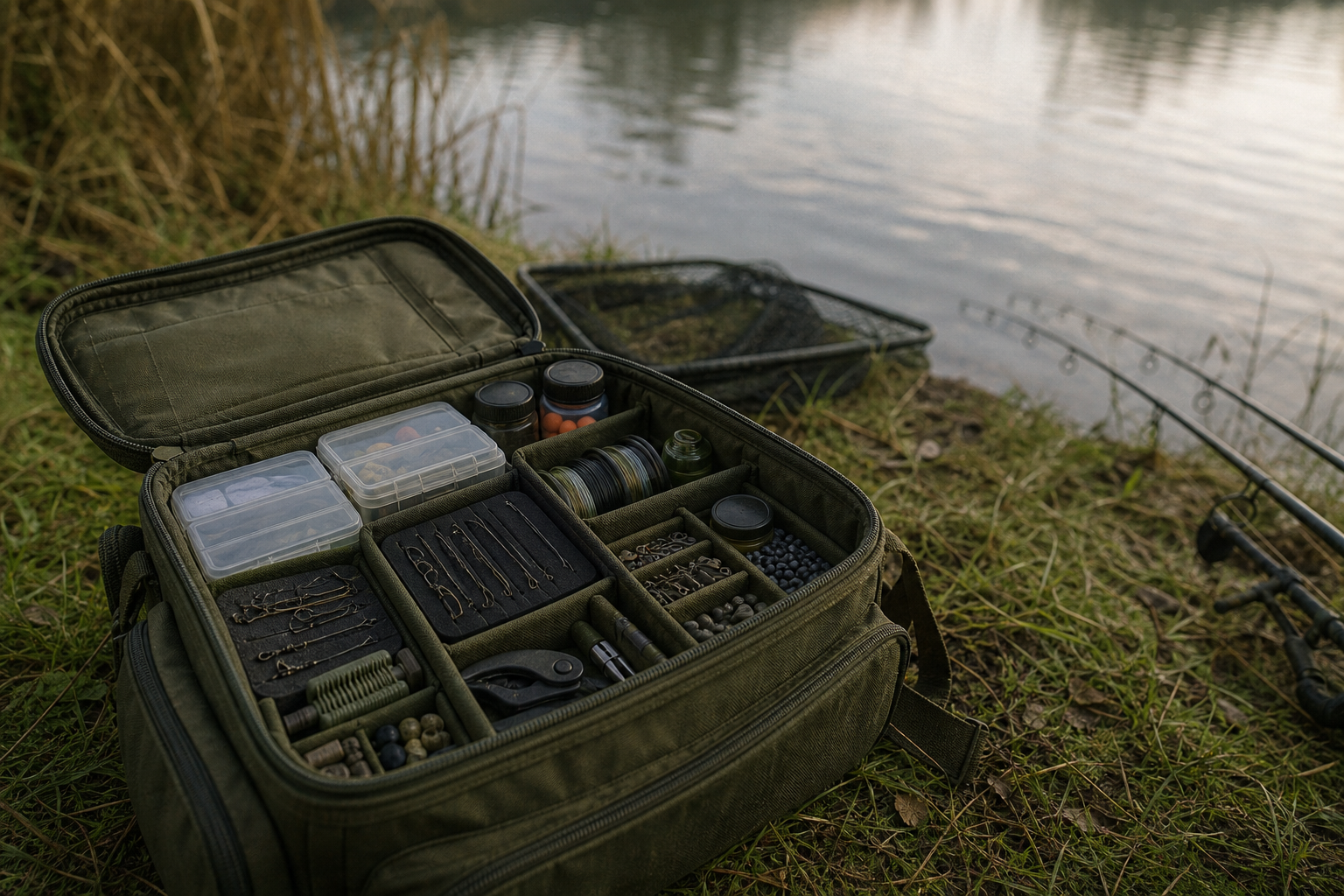
Tackle Bags for a Simple Coarse Fishing Setup
For a simple coarse setup choose a mid-sized carryall (30 to 45 litres) with a wipe-clean base, solid zips and a padded strap. A wide opening keeps fish-care kit and tackle easily reachable.
You are putting together a coarse fishing setup and you need something to carry it in. This article is about shoulder-style carryalls and tackle bags specifically: not rucksacks, not rod holdalls, not match luggage systems. The guiding principle throughout is straightforward: the right coarse fishing tackle bag for a simple setup is mid-sized, easy to open at the bank and practical on muddy ground.
What a coarse fishing tackle bag actually needs to do
Before looking at any specific products, it helps to understand what kind of bag you are actually looking for, and why the options sold in fishing shops differ from general outdoor luggage.
Three types of bag come up repeatedly when anglers start shopping: a rod holdall, a tackle carryall and a rucksack. They are not interchangeable. A rod holdall is a long, typically tubular bag designed to protect rods and landing net poles during transport. It does not carry your tackle. A tackle carryall is a wide-opening shoulder bag designed to sit beside you at the peg and hold your boxes, bait, tools and accessories throughout a session. A rucksack is a walking bag, worn on the back, with a main compartment accessed from the top.
For coarse fishing, a rucksack is usually the wrong choice, even though it might seem practical at first. The problem is access. When you are fishing, you are opening and closing your bag frequently: retrieving a different hooklink, swapping float sizes, reaching for forceps when you land a fish. A rucksack makes this awkward because the gear is buried vertically and the bag needs to be lifted off the ground or leaned against something to open properly. It also tends to sit unstably on uneven or soft ground, and the back panel and straps pick up mud and water. It is designed for walking, not for sitting beside a lake for three hours.
A tackle carryall, by contrast, opens wide at the top or front, sits flat on the bank, and keeps your session gear organised and accessible. That is what makes it the right format for coarse fishing.
For a simple coarse setup, your bag needs to hold a realistic collection of gear: a tackle box or two, spare hooklengths, a float wallet or some loose floats, a selection of feeders or weights, a bait tub or two, forceps, a disgorger and an unhooking mat, either rolled or folded. Most commercial fisheries in England require anglers to use an unhooking mat, though this is a fishery rule rather than a universal national requirement: check the rules of your specific venue. The point is that a mat needs to fit, which influences minimum bag size.
The difference between a smaller tackle bag and a larger carryall is mostly one of scale and intent. A tackle bag is typically more compact, suited to very light sessions with minimal gear. A carryall is designed to sit beside you all session and hold most of what you need. For the kind of simple, day-session coarse fishing this article is aimed at, either can work, but a mid-sized carryall gives you more room to grow without becoming unwieldy.
Bag or carryall?
A tackle bag usually refers to a smaller shoulder bag for the basics. A carryall is larger and designed to sit beside you at the peg throughout the session. For a simple coarse setup, either can work, but a mid-sized carryall gives you more room to grow without becoming unwieldy.
The features that matter on a simple coarse setup
These are the practical criteria to apply when evaluating any bag, not just the ones recommended later in this article.
Capacity
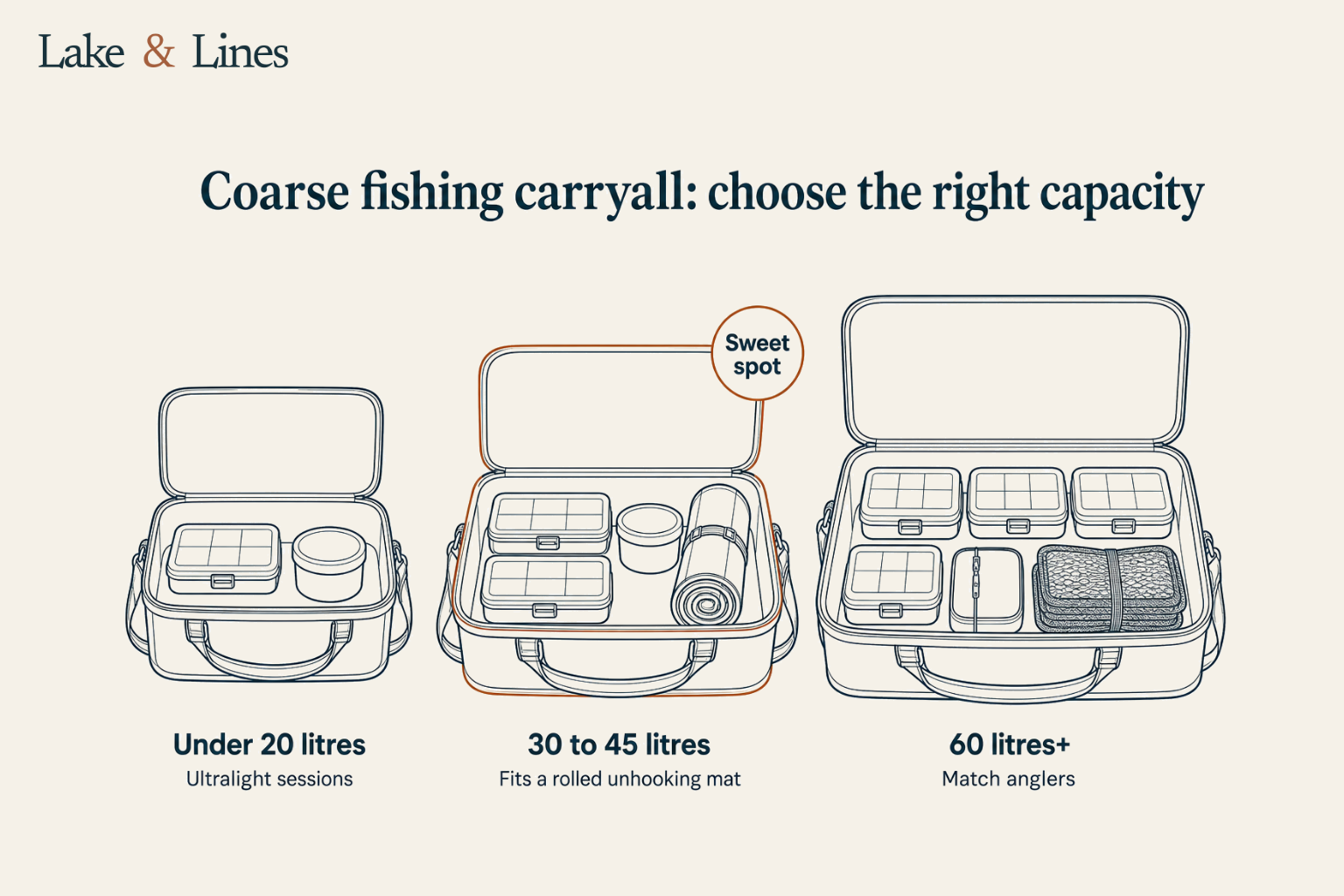
For a simple coarse fishing setup, roughly 30 to 45 litres is the practical sweet spot. That range fits two modest tackle boxes, a bait tub, a rolled unhooking mat, float storage, terminal tackle and tools without the bag becoming a heavy burden to carry from the car park.
A 60-litre match carryall is a different product for a different angler. It is designed for match fishing, where an angler arrives with multiple keepnets, seatbox accessories, several bait options and competition-specific gear. For a first or casual setup, a 60-litre bag is typically oversized, heavier when empty than a mid-sized bag when full, and awkward to organise when it is only half-used.
A bag under 20 litres is workable only if you fish very light: one rod, one or two bait options, minimal terminal tackle. Once you add an unhooking mat and a second tackle box, most small bags run out of room quickly.
| Bag size | What it suits | When to go bigger |
|---|---|---|
| Under 20 litres | Ultralight sessions, one or two bait options | If you carry a mat, multiple boxes or bait |
| 30–45 litres | Most simple coarse setups, day sessions | When you add keepnet, extra nets or match gear |
| 60 litres+ | Match anglers, seatbox accessories, multiple nets | Usually more than a first-timer needs |
Materials and base
Two main materials are used in fishing carryalls: fabric and EVA.
Fabric bags, usually made from 840D nylon or a similar heavy-weave material, are flexible, comfortable to carry and widely available across all price points. They compress slightly when not full, which makes them easier to store. The trade-off is that fabric absorbs moisture over time and can be harder to clean thoroughly if bait spills inside.
EVA (a firm, waterproof plastic foam) bags are rigid or semi-rigid and fully waterproof. They wipe clean easily, which is particularly useful if you carry damp bait tubs or a soggy landing net mesh. They hold their shape whether full or half-empty. The slight downside is that they are less flexible on the shoulder over longer walks, and the firmer construction adds a little weight compared with a fabric bag of equivalent capacity.
Both are practical choices. If you regularly carry wet items and want easy cleaning, EVA is a reasonable preference. If you want a slightly lighter, more comfortable carry and are careful with spills, a quality fabric bag is equally suitable.
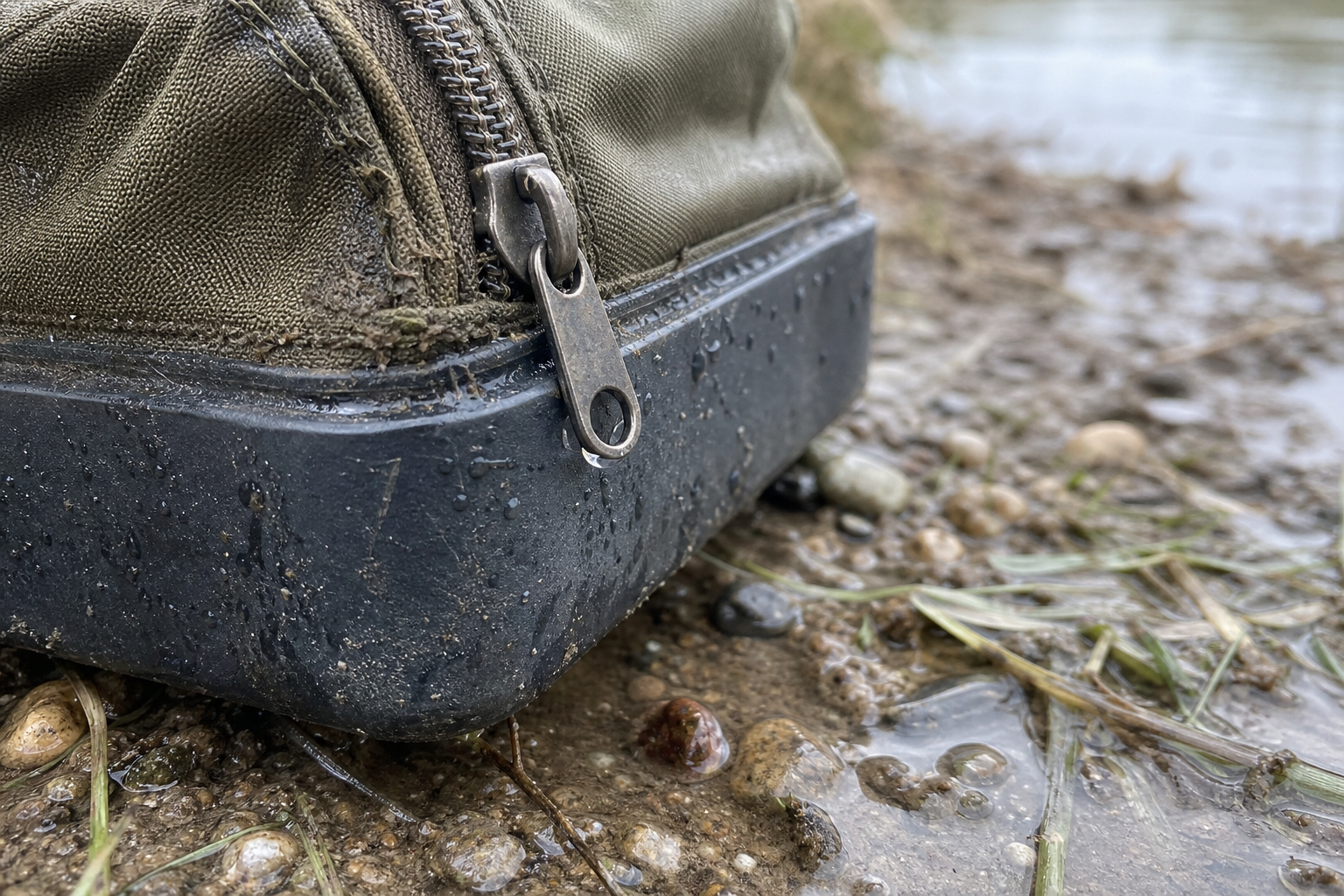
Whatever the main material, the base of the bag matters considerably on British fisheries. Banks are regularly wet, muddy or covered in damp grass. A bag with a rubberised, reinforced or otherwise wipe-clean base survives this far better than one with fabric right down to the bottom. After a few wet sessions, the difference is obvious: a rubberised base can be wiped down in seconds, while a fabric base stays damp and picks up mud that is difficult to remove.
Zips and hardware deserve a mention too. Fishing bags are opened and closed repeatedly in wet and gritty conditions. Cheap zips that corrode, stiffen or shed their sliders after a season are a genuine frustration. Look for zips that run smoothly and have some resistance to corrosion; this is one area where better-made bags genuinely last longer.
Carrying comfort
The most practical carryalls combine two carrying options: a padded shoulder strap for the walk from the car to the peg, and strong grab handles for lifting the bag in and out of the car boot and repositioning it at the bank mid-session.
These two uses are distinct. The shoulder strap does the longer work; a padded version makes a meaningful difference if your peg is a few minutes' walk from the car park. The grab handles are used for shorter lifts and adjustments. Both should feel solid and well-attached at the fixings.
As noted earlier, a rucksack design is not recommended for coarse fishing. The issue is not the walking comfort; some rucksacks are perfectly comfortable to carry. The issue is what happens at the bank, where a rucksack sits awkwardly on uneven ground, resists quick access to its contents and makes organising a session more complicated than it needs to be.
Recommended coarse fishing tackle bags and carryalls for UK anglers
The products below are chosen for their suitability for a simple coarse setup and their availability from UK tackle retailers including Angling Direct and Fishing Republic. This is a researched roundup: the recommendations are based on product specifications, construction details and available angler feedback rather than direct testing by this site. Prices were checked at the time of writing and are subject to change; confirm current pricing and availability before purchasing.
Budget options (under £25)
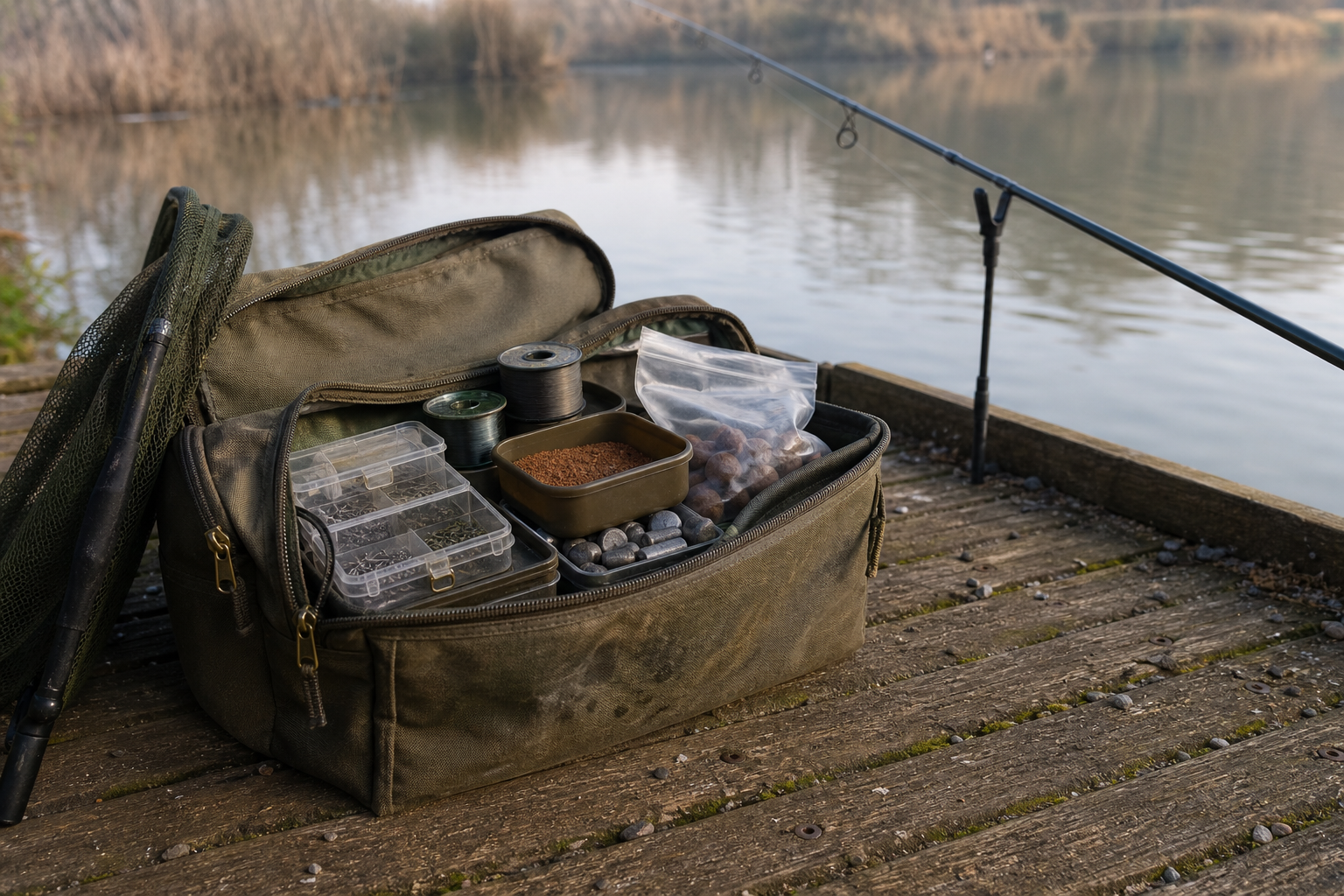
Entry-level fabric tackle bags and basic holdalls in the £10 to £25 range are widely available from UK online retailers. At this price point, you are looking at simpler construction, fewer internal pockets, lighter-gauge fabric and zips that will show wear faster with regular use. That is an honest assessment, not a reason to dismiss them entirely.
For an angler who is genuinely just starting out and wants to keep initial outlay modest while spending more on a rod, reel and licence, a budget bag is a sensible short-term choice. It will carry your gear through your first season. Whether it holds up into a second depends on how often you fish and how carefully you treat it.
One category to be aware of in this price range: "rod and tackle" combo holdalls that combine a rod sleeve with a small tackle section. These are sold for convenience and are useful for storing a setup at home or transporting it in the car. They are not carryalls. The combined format means the tackle compartment is cramped and often awkward to access when you are sitting at the peg. If you see one of these, treat it as transport storage rather than a session bag.
Mid-range carryalls (£40–£65)
This is the band that suits most weekend and first-time coarse anglers. The construction is noticeably more durable, the organisation is better thought through and the carrying features are genuinely more comfortable. For most readers of this article, starting here is a reasonable decision.
Garbolino Pro Tackle Bag EVA (41 litres, approximately £50 to £60) EVA construction throughout, including a fully waterproof wipe-clean interior and a rubberised base. The rigid sides hold their shape when the bag is open at the bank. Well-suited to an angler who carries bait tubs and wants to keep wet items contained without worry. The boxy profile is slightly less comfortable on the shoulder over longer walks compared with a fabric bag of similar size, but for most car-to-peg distances on UK commercial fisheries this is not a significant issue. Not the best choice if your peg involves a long footpath walk.
Maver MV-R Carryall Small (approximately £40 to £50) A compact, fabric-construction carryall with a tidy internal layout and a rubberised base. Suits an angler fishing light: one rod setup, a couple of tackle boxes and a few bait options. Comfortable to carry and well-organised. The limitation is capacity: if your tackle grows quickly over the first season, you may find yourself wanting more room within a year. Worth considering if you know your fishing will stay light and mobile.
Matrix Ethos Tackle and Bait Bag (approximately £45 to £55) Designed to carry bait and tackle together, which makes it a practical one-bag solution for a session beside the peg on a commercial stillwater. The internal layout reflects a feeder or float angler's typical session needs. Suits the angler fishing a day ticket venue with a single rod setup and a couple of bait choices. Less suited to sessions where you want to carry a keepnet or additional net accessories, as the main compartment is not the largest in this bracket.
Preston Innovations Supera X Compact Carryall (approximately £45 to £55) A fabric carryall from a well-regarded match fishing brand, available in a smaller size that suits a modest setup without the full match-luggage scale. Multiple external pockets, a padded shoulder strap, rubberised base and solid zip hardware. Suits a first-time or weekend angler who wants a properly constructed bag that will hold up over several seasons. The Preston name carries strong brand recognition in UK coarse fishing, and the smaller Supera format avoids the oversized match-carryall problem.
| Product | Approx. price | Construction | Best for | Main limitation |
|---|---|---|---|---|
| Garbolino Pro EVA 41L | £50–£60 | EVA, waterproof | Bait and wet items | Less comfortable for long walks |
| Maver MV-R Carryall (Small) | £40–£50 | Fabric | Light, organised setups | Limited if tackle grows quickly |
| Matrix Ethos Tackle and Bait Bag | £45–£55 | Fabric | Commercial stillwaters, feeder fishing | Not suited to large net storage |
| Preston Supera X Compact Carryall | £45–£55 | Fabric | All-round weekend angler | Steps up to match brand sizing |
Larger carryalls and luggage sets (£65–£90+)
Most readers of this article do not yet need a bag in this bracket. These products are included for completeness and for anglers who know from the outset that they intend to fish matches, join a club or build a more substantial setup quickly.
Tri-Cast Super Deluxe Match Carryall (60 litres, approximately £65 to £80) A large, well-constructed fabric carryall with a generous main compartment, multiple external pockets, a rubberised base and a padded shoulder strap. The manufacturer describes it as built for the serious match angler, and the capacity reflects that. If you are carrying a keepnet, a landing net, multiple rod setups and match accessories, this works well. For a simple first setup, it is too large: you will carry a half-empty bag that is heavier than it needs to be, and the open main compartment will swallow small items.
Daiwa Coarse Luggage Set (carryall and keepnet bag, approximately £80 to £95) An integrated system that combines a main carryall with a dedicated keepnet bag, sold as a bundle. The value compared to buying pieces separately is reasonable. Suits an angler who wants a cohesive, matched solution from the start and expects to use all the components quickly. The higher outlay and the inclusion of a keepnet bag make this a less sensible first purchase for someone who is not sure yet how often they will fish or whether they will use a keepnet at all.
What to put in your coarse fishing tackle bag
Choosing the right bag is only part of the decision: what goes in it determines how useful it actually is at the bank. This is covered in full in our coarse fishing kit checklist, which walks through everything you are likely to need for a day session.
For now, the essentials worth noting here are the fish-care items: an unhooking mat, a disgorger and forceps. These should always be in the bag, and they should be in a place you can reach immediately when a fish is on the bank. Most commercial fisheries expect anglers to use an unhooking mat, so treat these items as non-negotiable rather than optional accessories.
A short list of session essentials to keep in the bag:
- Unhooking mat (rolled or folded to fit)
- Disgorger
- Forceps
- Tackle box with hooks, floats, weights and terminal tackle
- Spare hooklengths or a hooklink wallet
- Bait tub or bag
- Scissors or a line cutter
- Rod licence (or proof of licence on your phone)
Keep fish-care tools accessible
Most commercial fisheries in England require an unhooking mat. Keep your mat, disgorger and forceps in an external pocket or at the top of the main compartment so you can reach them immediately when you land a fish.
Choosing the right coarse fishing tackle bag for where you fish
The bag that suits you depends not just on what you carry, but where you fish. These two things are worth thinking about together before you buy.
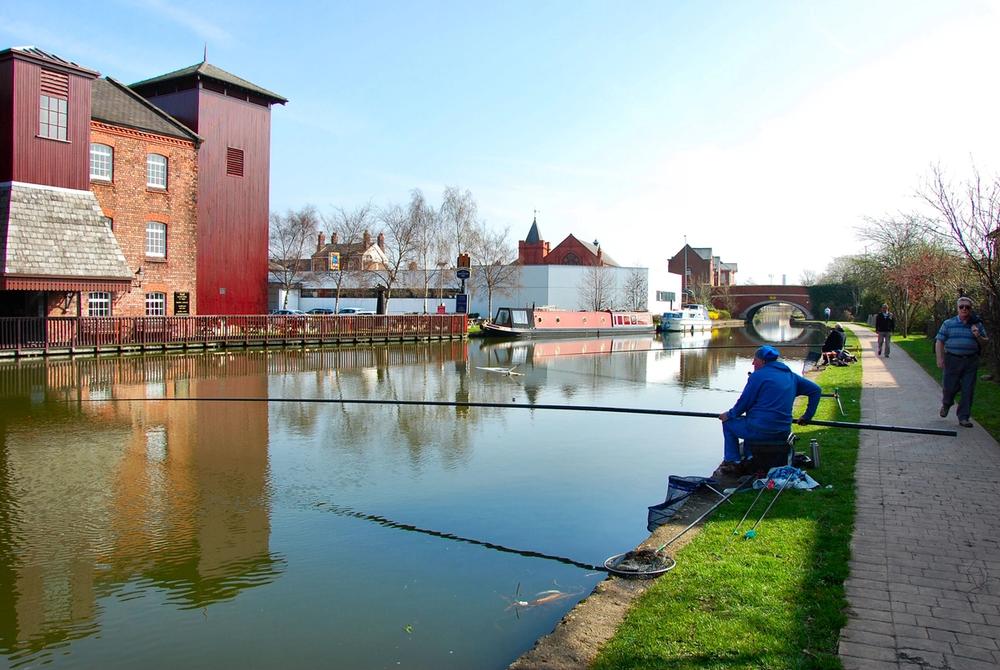
Canal or river fishing typically means a walk along a towpath or riverbank to reach your peg. Space at the waterside can be limited, particularly on a busy canal towpath or a narrow river margin. A compact mid-sized bag in the 30 to 35-litre range is noticeably easier to manage in these situations. A 60-litre match carryall is a physical obstruction on a narrow towpath and takes up peg space that may already be restricted.
Small commercial stillwaters are the most common setting for first-time and weekend coarse anglers in the UK. Pegs tend to be more spacious, the walk from the car park is usually short, and leaving the bag open beside you throughout the session is entirely normal. A mid-sized carryall in the 35 to 45-litre range works very well here. You can open it fully, access gear easily and leave it stable on a flat or gently sloping bank.
Larger venues and club matches are where a bigger carryall or a luggage system starts to make sense. If you are carrying a keepnet for a match, extra rod setups, a full set of match accessories and multiple bait options, a 45-litre bag will be cramped. This is the situation the larger bags in the £65-plus bracket are designed for. It is worth waiting until you are sure this is how you fish before investing at this level.
A point worth keeping in mind throughout: a bag you can carry comfortably from the car park to the peg in a single trip is always preferable to one that needs two trips or, worse, one that gets left in the car because it is too heavy and cumbersome to bother with. A heavy, half-filled carryall is rarely the right choice at any stage of a fishing setup, and it is almost never right at the beginning.
Start with what you actually need. A mid-sized fabric or EVA carryall in the £40 to £60 bracket, with a rubberised base, solid zips and a padded shoulder strap, will handle a simple coarse setup for several seasons without complaint. You can always step up later when you know exactly what the next bag needs to do.
Frequently asked questions
What size coarse fishing tackle bag should I buy?
Aim for a mid-sized bag around 30 to 45 litres. That fits two small tackle boxes, a bait tub and a rolled unhooking mat without becoming too heavy or bulky.
Fabric or EVA construction: which is better?
Both work. Fabric bags are lighter and more comfortable to carry. EVA is rigid, fully wipe-clean and better for wet bait or soggy kit. Choose EVA if you often carry damp items.
Is a rucksack a good choice for coarse fishing?
No. A rucksack is designed for walking. It buries gear vertically and is awkward to open at the bank. A wide-opening carryall sits beside you and gives fast access to session kit.
Which features matter most on a coarse fishing carryall?
Prioritise a wipe-clean or rubberised base, solid corrosion-resistant zips, a padded shoulder strap and strong grab handles. A wide opening and sensible internal layout are also key.
What must I keep easily accessible in the bag?
Keep fish-care items at the top or in an external pocket: unhooking mat, forceps and a disgorger. Also have a tackle box, spare hooklengths, bait tub and a line cutter ready to hand.

Lake & Lines Editorial Team
Editorial team
The Lake & Lines editorial team brings together freshwater fishing guides and researched tackle advice, helping beginners and returning anglers prepare for better days by the water.