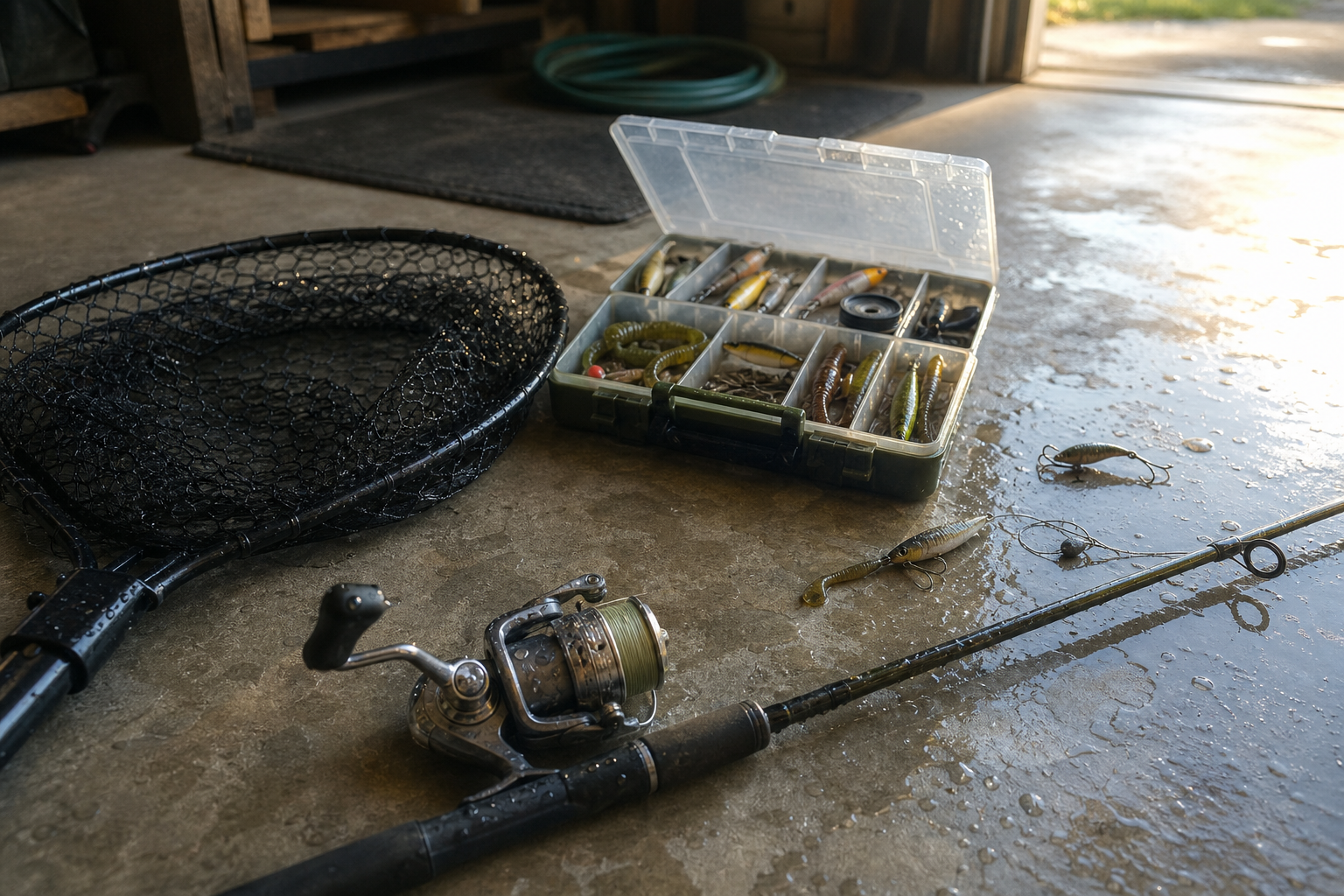
Caring for Your Rod, Reel and Tackle After a Session
A short post-session routine protects rods, reels, line and soft kit, prevents corrosion and helps stop spread of invasive species. Check, clean and dry gear and dry soft items for at least 24 hours.
At a Glance
- A brief 10 to 15 minute home routine after every trip prolongs gear life and reduces biosecurity risks.
- Wipe rod blanks, inspect guides for chips or grooves, and dry rods before storing in sleeves or holdalls.
- Rinse reels with warm fresh water, dry with the bail open and keep lubrication work to manufacturer guidance or a service.
- Dry soft kit, nets and waders for at least 24 hours and use hot water treatment for high risk situations when appropriate.
- Store reels and line in the dark, keep terminal tackle dry and discard rusty hooks to protect fish welfare and tackle performance.
You've just got home from a session. The gear is damp, the net is bundled in a bag and everything is heading straight back into the boot of the car or under the stairs. It's a familiar end to a day's fishing, but a short routine at this point makes a real difference: good fishing tackle care protects your equipment, keeps it performing properly and, increasingly in the UK, it's part of how responsible anglers look after the waters they fish. This guide walks you through exactly what to do, item by item, so the routine becomes second nature.
Why post-session care matters more than most anglers realise
Damp tackle stored in a sealed bag does not simply dry out over time. Moisture trapped in a rod holdall, a folded net or a closed reel case creates the right conditions for corrosion on metal components, mould on soft materials and accelerated degradation of monofilament line. You might not notice the effects after one session, but the cumulative impact on guides, reel bearings and net mesh is real. A fifteen-minute routine after every trip is considerably less expensive than replacing corroded rings or a seized bail arm.
The second reason is more significant than many anglers realise. Moving damp equipment between fisheries is one of the primary routes by which invasive non-native species spread through UK waters. Species such as signal crayfish, killer shrimp and plants like floating pennywort can survive in damp nets, waders and mat folds for days, sometimes weeks. Once established in a water, they are almost impossible to remove. The Check, Clean, Dry campaign, backed by DEFRA, the Environment Agency, the Angling Trust, DAERA and the Non-Native Species Secretariat, exists specifically to address this risk. It is not a bureaucratic formality: it reflects a genuine and ongoing threat to freshwater habitats across England, Wales, Scotland and Northern Ireland.
UK fisheries are increasingly making dry, clean kit a condition of entry. Some operate dry-net policies on the gate. Most display Check, Clean, Dry signage and a growing number provide on-site disinfection stations. Understanding what this means in practice, and building it into your post-session habit, is part of fishing responsibly in Britain today.
Cleaning and drying your fishing rod
Wiping down the blank and guides
Start with the rod. Lay each section out on a flat surface or prop it somewhere stable. Take a soft, damp cloth and wipe down the full length of the blank, working from butt to tip. You're removing mud, algae, fish slime and any general grime that has accumulated during the session. Follow immediately with a dry cloth to remove the residual moisture.
Pay particular attention to the guides. Grit that lodges in the inner surface of a ring does not sit there harmlessly: it acts as an abrasive every time line passes through it during a cast or retrieve. Work gently around the inside of each ring with your cloth, and give the tip ring the same treatment. The reel seat deserves attention too, especially the thread and locking rings, which trap grit between sessions. Wipe these clean and check that the seat still holds the reel securely without any movement.
Once the rod is clean, let it dry before it goes into a sleeve or holdall. Laying it across a couple of chairs, propped against a wall or rested on a rod stand indoors for twenty minutes is enough. What you want to avoid is putting a damp rod into a sealed sleeve, which simply holds the moisture against the blank and the whippings.
What to look for when you check the guides
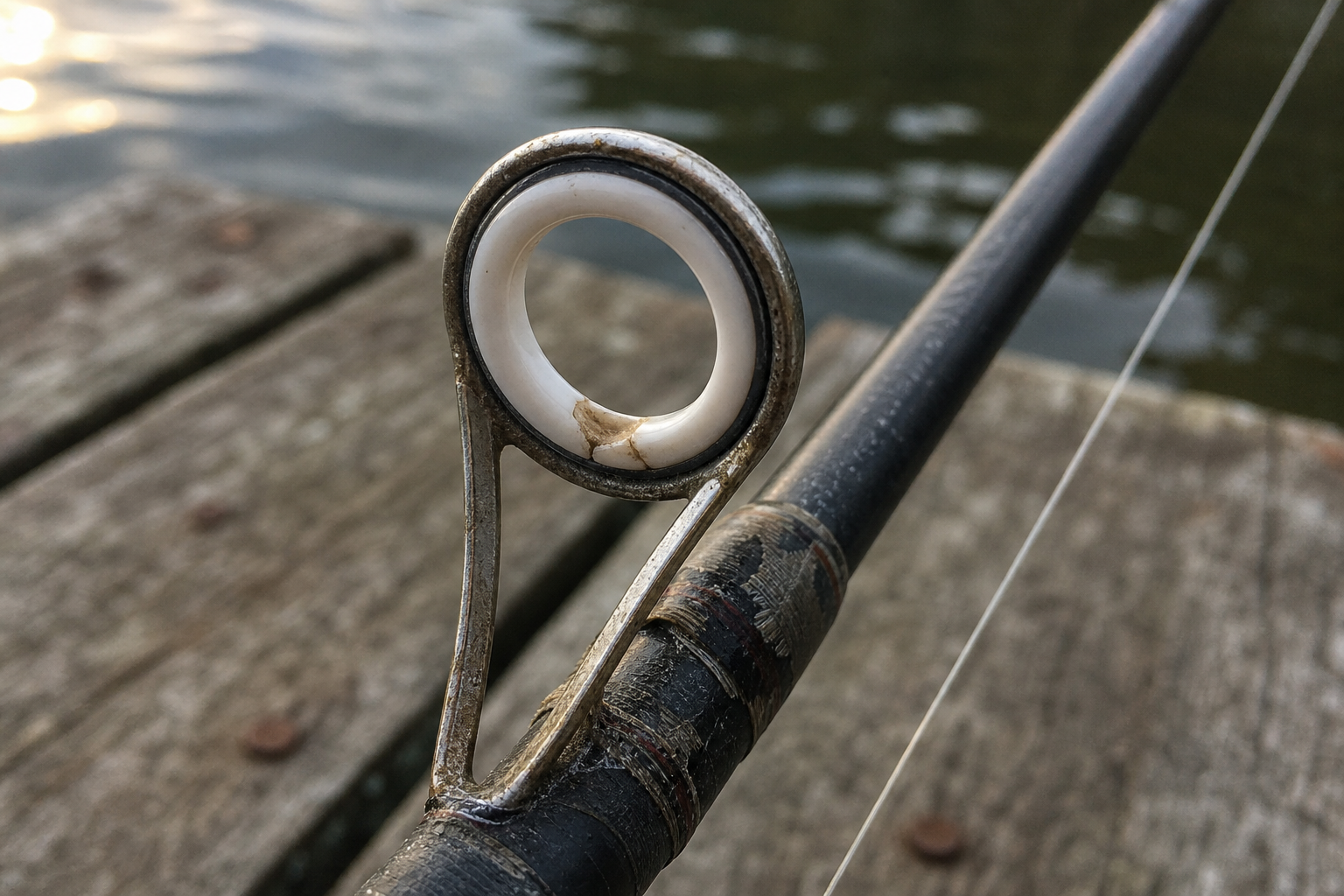
Cleaning is a good opportunity to inspect the guides properly. Run a piece of cotton wool or the tip of your finger gently around the inside of each ring. If it snags, catches or feels rough, there is likely a chip or groove in the insert. A chipped guide will damage your line under casting load: it cuts into the surface as the line accelerates through, causing fraying that you may not notice until the line breaks at a critical moment.
A grooved tip ring is particularly worth catching early. Line under load on a bent rod exerts considerable pressure through the tip ring, and a groove will work through monofilament surprisingly quickly. If you find a chip or groove, replace the guide before your next session rather than hoping it will cause no further damage.
Check the guide feet and whippings while you are at it. If a whipping is starting to lift or fray, it should be re-varnished or rewound before it progresses. Rods that are kept clean are easier to inspect accurately because surface grime does not obscure developing problems.
Store rods away from direct sunlight and heat. UV light and sustained warmth degrade rod finishes and the adhesives used in guide feet and tip rings over time. A rod cupboard, holdall or sleeve kept in a cool, dry space is preferable to leaning rods against a wall next to a sunny window.
Looking after your reel after a fishing session
Rinsing and wiping the exterior
Give the reel a rinse with warm (not hot) fresh water. A soft brush or an old toothbrush is useful for working around the bail arm, line roller and handle knobs, where grit and fine debris accumulate and are difficult to reach with a cloth alone. Work methodically around the body and rotor, then wipe everything down with a dry cloth.
Avoid strong detergents for routine post-session cleaning. Warm water removes surface grime effectively without risk of stripping the grease from internal components. Detergents designed for household cleaning can work their way past seals in cheaper reels and cause internal bearing problems over time.
Caring for the spool and line
Remove the spool from the reel body and wipe the line clean with a dry cloth, working from the top of the spool down. As you do this, feel for any rough sections, kinks or areas where the line feels stiff or flattened. Line that has been under repeated load, especially during feeder fishing or when playing fish over gravel or snags, degrades faster than line sitting on a rarely used spool.
If the line has been through a busy session, consider inspecting the top few metres more carefully before your next trip. There is no universal rule for when monofilament needs replacing: it depends on how hard it has worked, what it has been in contact with and how it has been stored between sessions. A practical approach is to inspect the top section after every ten or so sessions and replace the top portion if the line shows any roughness, visible kinks or a noticeably coarser texture than you would expect from fresh mono. Braid is more resilient to physical damage but still degrades with sustained UV exposure and heavy use.
Drying and storing the reel
After cleaning, allow the reel to dry with the bail arm open and the spool either removed or slightly tilted. This lets air circulate through the spool and around the rotor rather than trapping residual moisture in confined spaces.
Store the dried reel in a drawer, reel case or closed box rather than on open shelving. UV light causes monofilament line to become brittle over time, even through a window on a dull British day. A dark, dry environment is better for both the reel body and the line on the spool.
Avoid lubricating reel internals unless you understand clearly what you are applying lubricant to. A light application of reel oil to the line roller bearing is appropriate maintenance for many fixed-spool reels. Anything more involved, such as greasing the main shaft or drag washers, is better done following the manufacturer's guidance or by a reel service, rather than by applying household oil and hoping for the best.
Drying tackle after a session: what the guidance actually says
The principle is straightforward: everything that has been in the water, or in contact with water during the session, should be dried before it is used at a different fishery. The question most anglers have is how long that actually takes.
For soft kit, the current Angling Trust guidance recommends a minimum of 24 hours. This applies to landing nets, unhooking mats, weigh slings, waders and wading boots. The 24-hour figure is a minimum, not a guarantee: some invasive species can survive in damp conditions for considerably longer, which is why "as long as possible" is the more complete answer, and why some anglers who fish multiple venues maintain separate soft kit for their home water and for occasional visits elsewhere.
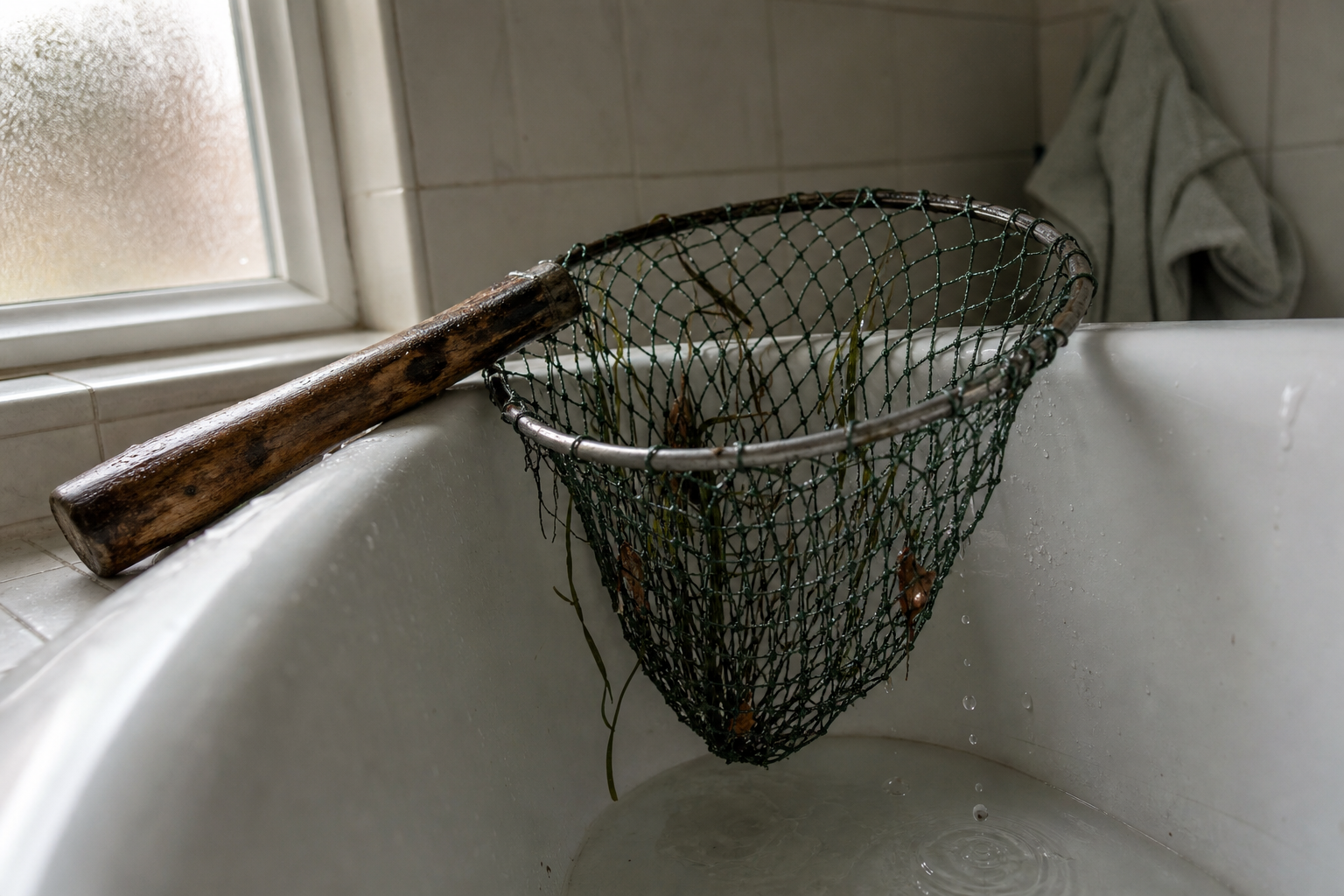
To dry properly, items need to be opened out and hung in circulating air, not bundled in a bag or folded over a bucket. In a typical UK home, a bath is a practical solution for a landing net: hang the net over the side or from a curtain rail so the mesh hangs freely. An airing cupboard works well for mats and slings. A well-ventilated garage is useful for waders and boots, ideally hung upside down so moisture drains from the foot rather than pooling inside.
Hot water at around 45 to 50°C, applied to soft items for at least 15 minutes, is an effective supplementary measure recommended by the Wild Trout Trust and Angling Trust for high-risk situations. This works well for landing net mesh, unhooking mats, weigh slings, waders and boots. It is not appropriate for reel internals, rod blanks or modern fluorocarbon and copolymer lines, which can be weakened or damaged by sustained heat. The key distinction is between soft gear, which generally tolerates hot water well, and the harder components of your setup, which do not.
To be clear about what this achieves: following these steps reduces the risk of spreading invasive non-native species significantly and is consistent with current guidance from the relevant UK bodies. It does not provide an absolute guarantee. The biology of some of the species involved is not fully understood, and conditions vary. The honest answer is that doing this carefully and consistently is meaningful, but "consistent with current guidance" is the correct framing, not "this makes the risk zero."
If you're fishing again soon
If you're moving between waters within 24 hours, consider keeping a separate set of nets and soft gear for each venue, or using a fishery-supplied net where available. This is the approach recommended in current Angling Trust guidance for anglers who travel regularly.
Terminal tackle, hooks and accessories
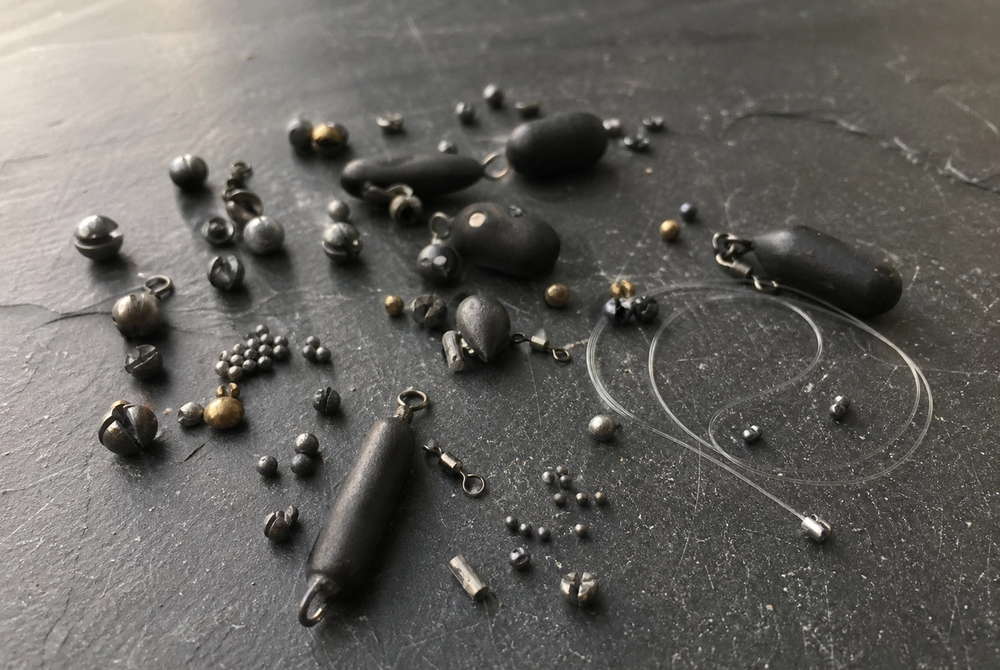
Terminal tackle is easy to overlook in the post-session routine, but hooks, swivels, lead weights, line clips and floats all benefit from a rinse and dry before they go back in the box.
Rinse everything in fresh water and lay it out on a cloth or towel to dry. Do not return damp items to a closed box: residual moisture in a sealed container causes accelerated corrosion, and a rusted hook can transfer corrosion to other items it sits against.
Discard any hook that shows rust. A rusty hook is not just a catch rate problem: it is a fish welfare issue. A hook that has lost its temper through corrosion will not penetrate cleanly and is more likely to bend or fail under pressure. The cost of a few discarded hooks is trivial compared to the risk of a poorly set hook that wounds a fish without landing it.
Check lead weights and in-line feeders for cracks or sharp edges from impacts on gravel or stones. A cracked feeder will affect presentation and can cause line damage at the point where the crack sits. Check float tips and bristles too. A damaged bristle does not transmit bites accurately and is easily replaced before it costs you a fish.
Storing your tackle between sessions
Rod sleeves and holdalls must be dry before the rods go in. A damp holdall zipped shut is a good environment for mould, particularly on the cloth and foam lining common in many compound rod holdalls. Leave the holdall and any sleeve zips open when the bag is empty and being stored, so air can circulate rather than concentrating any residual moisture.
Reel storage should be in a closed drawer or box rather than on open shelving. As noted above, UV light degrades monofilament line even through a window on an overcast day. Loose line spools should be stored in the dark too. Braid is more UV-resistant than mono but still benefits from covered storage over longer periods.
Keep terminal tackle dry and sorted by type. Hooks left loose in a damp box will corrode unevenly; hooks stored in their original packaging or in a dry, compartmented box stay sharper for longer and are easier to find when you need them.
The Check, Clean, Dry protocol and UK fishery rules
Check, Clean, Dry is a campaign run by the Non-Native Species Secretariat in partnership with DEFRA, the Environment Agency, the Angling Trust and, for Northern Ireland, DAERA. The Northern Ireland guidance is run separately by DAERA and should not be assumed to be identical in all operational details to the Environment Agency's approach in England and Wales, though the underlying principle is the same.
In practice, the protocol breaks down into three stages.
Check, Clean, Dry in practice
Check
Inspect all equipment for mud, weed, algae and water snails before leaving the water.
Clean
Rinse everything that has been in contact with the water using clean tap water, or warm water for reels and soft kit.
Dry
Allow all equipment to dry completely before using it at another water. Aim for at least 24 hours for nets, mats and waders.
Dry-net policies at fisheries mean the angler is expected to arrive with equipment that is already clean and dry. This is not a request: at venues that operate this policy, it is a condition of access. Some fisheries provide nets on site specifically to remove the barrier for anglers who have not had time to dry their own kit adequately.
Some fisheries, particularly on salmonid and high-value coarse waters, use Virkon Aquatic as a disinfectant at on-site stations. Virkon Aquatic is an approved product used in fishing biosecurity contexts. It is rinsed off before gear comes into contact with water or fish, and when used as directed it is safe for the equipment it is applied to. It is mainly relevant at commercial venues or those with a documented high-risk status. For everyday pleasure fishing at a local lake or canal, rinsing and drying thoroughly is what current guidance expects of you. The full Check, Clean, Dry guidance and further information about the campaign is available at the NNSS website (nonnativespecies.org).
A quick routine you can build into every session
The most useful thing about this routine is that it does not need to happen all at once. A two-stage approach is easier to sustain: a quick bankside check before you pack, and a ten to fifteen-minute home routine when you get back.
Before you pack up at the water, do a visual check for obvious mud, weed or plant fragments on your net, mat, waders and any item that has been in or near the water. Separate wet items from dry ones before everything goes in the bag.
When you get home:
- Wipe down the rod blank and guides with a damp cloth, then a dry cloth. Check guides for chips.
- Rinse the reel with warm water, dry it and leave it open to air before storage.
- Hang the landing net and any soft kit in a well-ventilated space for at least 24 hours before it goes near another water.
- Rinse and dry terminal tackle; discard any rusted hooks.
- Leave rod holdall and sleeve zips open for air circulation.
That is the full routine. It takes less time than most anglers expect, and it protects kit that is worth looking after. If you want a reference point for everything covered here, the table below gives you the essentials at a glance.
| Item | What to do | When to do it |
|---|---|---|
| Rod blank | Wipe with damp cloth, then dry cloth | After every session |
| Rod guides and tip ring | Check for chips; wipe clean | After every session |
| Reel exterior | Rinse with warm water, dry with cloth | After every session |
| Reel spool and line | Wipe line clean, check for damage | After every session |
| Landing net and mat | Rinse, dry for at least 24 hours | After every session before moving waters |
| Hooks and terminal tackle | Rinse and dry; discard rusty hooks | After every session |
| Waders and boots | Rinse, dry fully, check soles | After every session before moving waters |
Frequently asked questions
How long should landing nets, mats and waders be dried before using them at another fishery?
Dry soft kit for a minimum of 24 hours. Hang items open in circulating air and allow longer if possible. For high risk situations a 15 minute hot water treatment at 45 to 50°C is an effective supplementary measure.
What is a simple post-session routine I can do at home?
Spend 10 to 15 minutes: wipe rod blank and guides, rinse and air the reel with the spool open, hang nets and soft kit to dry, rinse and dry terminal tackle and discard rusty hooks, and leave holdall zips open to air.
How do I check rod guides for damage?
Run a fingertip or a piece of cotton around each ring. If it snags, feels rough or you see a chip or groove, replace the insert or guide before your next session to avoid line damage.
Can I use household detergents or heat on reels and line?
Avoid strong detergents and hot water on reel internals and modern lines. Use warm fresh water and a soft brush for routine cleaning and only apply lubricants per manufacturer guidance or have the reel serviced.
Why follow the Check, Clean, Dry protocol?
It protects kit from corrosion and mould and reduces the risk of spreading invasive non native species. Many UK fisheries require clean dry gear as a condition of access.

Lake & Lines Editorial Team
Editorial team
The Lake & Lines editorial team brings together freshwater fishing guides and researched tackle advice, helping beginners and returning anglers prepare for better days by the water.