Common Coarse Fish at a Stillwater: How to Recognise Them and Handle Them Properly
A simple three-step visual method to recognise common coarse fish on stillwaters, with practical handling tips, close season notes and when to ask for help.
At a Glance
- Use a three-step ID method: shape, mouth position, then fins and eyes to identify most stillwater coarse fish.
- Common species on beginner stillwaters include roach, rudd, bream, carp, crucian, tench, perch and occasional pike or zander.
- Handling varies by species: support large carp, protect tench slime, avoid perch dorsal spines and seek help for pike or eels.
- The 15 March to 15 June close season mainly affects rivers; always confirm local byelaws and fishery rules before fishing.
You've just landed something unfamiliar and it's sitting in your net looking nothing like what you expected. That's a common moment for anyone in their first few sessions, and it's worth sorting out quickly: the right handling depends on knowing what you've got. Common coarse fish identification doesn't need to be complicated. Most beginner stillwaters hold a fairly predictable mix of species, and a simple three-step visual method (body shape, mouth position, fins and eyes) gets you to a confident answer most of the time. Knowing the species also tells you which care and retention rules apply, and it means you'll get more from the session rather than second-guessing every fish you put back.
What Counts as a Coarse Fish in England and Wales
Under the national rod fishing byelaws for England and Wales, the listed coarse fish species are: barbel, chub, common bream, silver bream, common carp, crucian carp, dace, perch, pike, roach, rudd, tench, smelt and their hybrids. If you catch one of these, the rules around retention, close seasons and handling all fall under the coarse fish framework.
Two things worth knowing early: grayling is not included in that standard coarse fish list and is treated separately. Salmon and trout are game fish, not coarse fish, and carry different licence conditions and seasonal rules. On a typical commercial stillwater or club lake, you're very unlikely to encounter either, but it's useful to understand the distinction. These rules apply in England and Wales only. Scotland and Northern Ireland have their own frameworks.
Stillwater close season
The statutory coarse fish close season (15 March to 15 June) applies to rivers, streams and drains in England, not to most lakes, ponds and canals. Some designated stillwaters, including certain SSSIs, are exceptions. Always check local byelaws and the fishery's own rules before you fish.
A Simple Method for Common Coarse Fish Identification
The mistake most beginners make is trying to name a fish before they've really looked at it. Work through these three steps in order and you'll narrow the field down quickly, even without a field guide.
Step One: Body Shape
Before you look at anything else, step back and take in the overall shape. Most stillwater coarse fish fall into one of four broad categories:
- Deep and slab-sided: The fish is noticeably tall relative to its length, quite flat when viewed from the front. Common bream and large carp both sit here.
- Thick, rounded and compact: A smaller, chunky fish with a high back and rounded body. Tench and crucian carp fit this profile.
- Long and torpedo-shaped: An elongated body built for speed or ambush. Pike are the most obvious example; chub and dace are more modest versions of the same general outline.
- Slim and moderately deep: Neither very round nor very long. Roach, rudd and perch all sit in this middle category, which is why they're often confused.
Shape alone won't give you a final answer, but it rules out a lot of possibilities before you've done anything else.
Step Two: Mouth Position
Where a fish's mouth sits tells you a great deal about where it feeds, and it's a reliable identification marker when combined with body shape.
- Downturned: The mouth points toward the riverbed. Bottom feeders: bream, barbel and most carp have a distinctly downturned mouth designed for rooting around on the lakebed.
- Level: The top and bottom lip meet at the same point, giving a roughly horizontal line. Roach, tench and chub all feed across a range of depths and have level mouths.
- Upturned or with a protruding lower lip: The lower jaw extends slightly beyond the upper, or the mouth tips upward. This indicates a fish that often feeds near the surface or in the upper water layers. Rudd is the classic example.
Step Three: Fins and Eyes
This is where you confirm the identification. A few specific cues do most of the work:
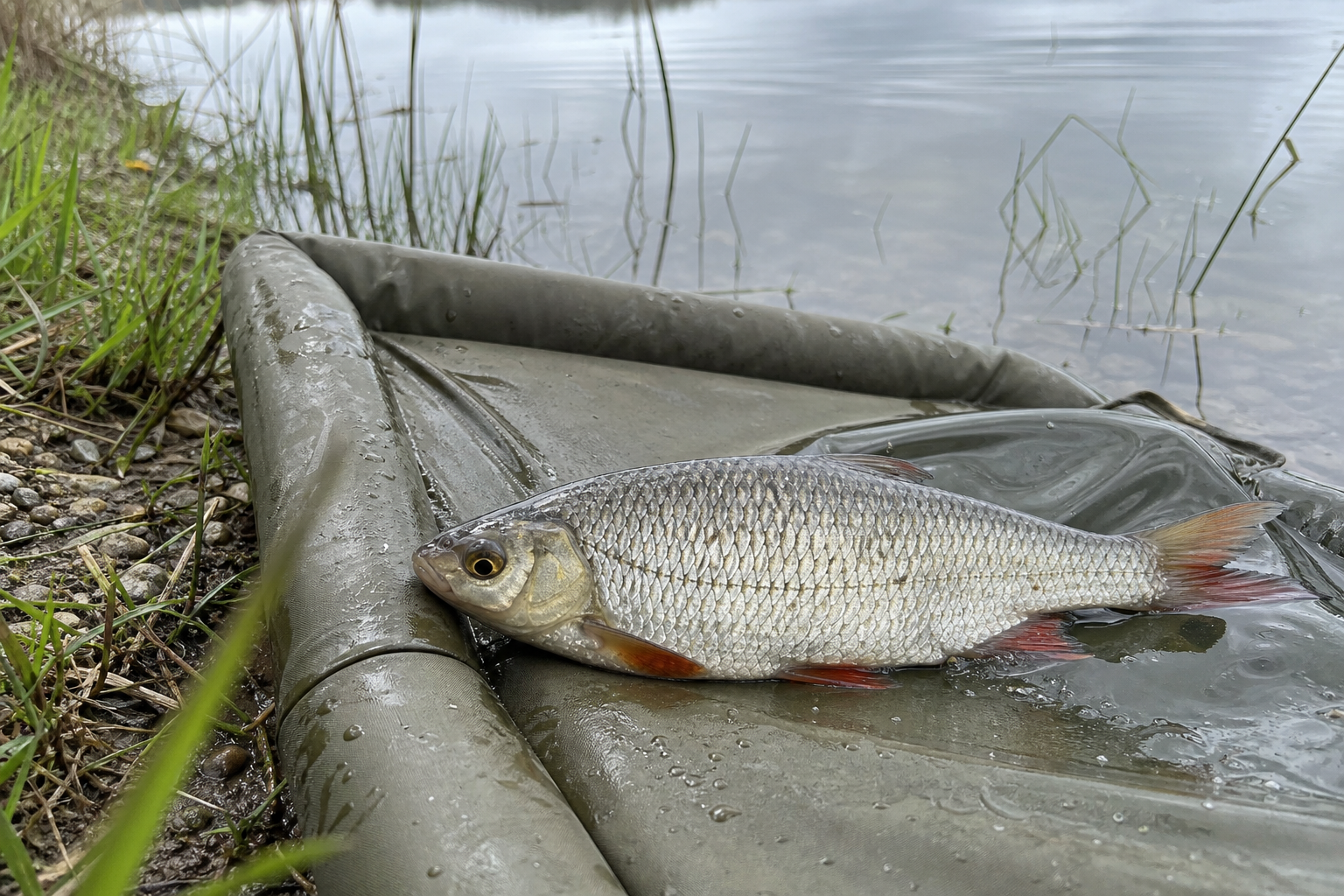
- Red or orange-red fins and orange-red eyes on a silver-scaled fish: That's a roach.
- Deeper red fins and a dorsal fin (the fin along the top of the back) set noticeably behind the line of the pelvic fins (the paired fins on the belly): That's a rudd.
- Two dorsal fins, bold dark vertical stripes across the flanks and orange-red pelvic fins: Perch, unmistakable once you know what to look for.
- Very small, fine scales, a thick olive-green body and small rounded fins: Tench. They also have a noticeably thick slime coat (the protective mucus layer covering the body).
- Scattered large scales or an apparent absence of scales on a deep-bodied fish: Mirror or leather carp respectively.
- A compact, bronze-gold, fully scaled body with no barbels (the small whisker-like sensory organs at the corners of the mouth) and a high, convex dorsal fin: Crucian carp.
| Pair | Key difference | Look here first |
|---|---|---|
| Roach vs rudd | Dorsal fin position | Rudd's dorsal starts behind the pelvic fin line; roach's dorsal is roughly above it |
| Common bream vs silver bream | Size and colouring | Silver bream is smaller and brighter silver; common bream is more bronze and slab-sided |
| Tench vs carp | Scale size and body feel | Tench have tiny scales and a thick slime coat; carp have larger visible scales (except leather carp) |
| Crucian carp vs small common carp | Mouth | Crucian carp has no barbels; common carp has two pairs of barbels at the corner of the mouth |
| Perch vs small pike | Stripes and body shape | Perch has vertical stripes and two dorsal fins; pike is longer with mottled horizontal markings |
The Species You Are Most Likely to Find on a Beginner Stillwater
Commercial fisheries and club lakes in England and Wales are stocked with a fairly predictable range of species. Here's what you'll most likely be identifying on the bank.
Roach and rudd are often grouped together as "silver fish" and with good reason: they look similar at first glance. Both are slim, silver-scaled fish with reddish fins. The key is the dorsal fin. On a roach, it starts roughly above the pelvic fins. On a rudd, it sits clearly further back. Rudd also tend to have a slightly more golden tint to their scales and a more obviously upturned lower lip.
Common bream is hard to mistake once you've seen one. It's a very deep, flat-sided fish with a small head, a noticeable slime coat and scales that run to bronze-brown on older, larger fish. Small bream (sometimes called "skimmers") are more silver and can be confused with silver bream, which is a genuinely separate species: smaller, brighter and with a more rounded body.
Tench are one of the most distinctive fish on any stillwater. That thick olive-green body, tiny rounded scales, thick slime and small red eye make them easy to recognise once you've held one. They're solidly built fish that feel heavier than their length suggests.
Common carp is the species many beginner stillwaters are built around, and they come in several physical forms. Fully scaled common carp have large, regular scales across the whole body. Mirror carp have irregular patches of large scales, often along the back and flanks, with bare skin in between. Leather carp have almost no scales at all. All share the same basic body plan: deep, powerful, with a large downturned mouth and two pairs of barbels at the corners.
Crucian carp are often stocked alongside common carp and confused with small commons, particularly by beginners. The single reliable check: open the mouth and look for barbels. Crucian carp have none. A small common carp always has two pairs. Crucians also tend to be more uniformly bronze-gold and more rounded in profile.
Perch are one of the most visually striking fish you'll find on a stillwater. Bold dark vertical stripes, a spiky first dorsal fin and vivid orange-red lower fins make them unmistakable. They're predatory and compact, and even small perch carry those distinctive markings.
Pike and zander are less commonly encountered on commercial beginner fisheries but do appear on some club waters and larger stillwaters. They're worth knowing by sight. Pike are long, mottled greenish-brown, with a huge mouth full of backward-pointing teeth and a single dorsal fin set far back near the tail. Zander are slimmer, more upright in posture, with large glassy eyes and a more uniform grey-green colouring. Both require specific handling.
Handling Differences That Matter by Species
Getting the identification right is only half the job. Here's what changes depending on what you've caught.
Fish That Need No Special Adjustment
For roach, rudd, bream and smaller tench, the basics cover you: wet your hands before touching the fish, support its body rather than gripping it tightly, keep it low over an unhooking mat, and return it promptly. These are the routine coarse fish most beginners encounter first, and they don't require any specialist approach beyond careful, calm handling.
Large Carp and Tench: Weight and Slime
Larger carp need proper support. Anything over a few pounds should be landed into a suitably sized net, transferred onto an unhooking mat or cradle and held with two hands when lifted, one under the pectoral fins (the fins on either side behind the head) and one supporting the body. Many fisheries list an unhooking mat and appropriate net size as compulsory kit for carp fishing, not just good practice.
Tench present a different challenge: that thick slime coat makes them genuinely slippery. Hold them firmly with both hands and keep them as close to the mat surface as possible at all times. The slime is there to protect the fish, so avoid wiping it off or handling the fish more than necessary.
Spiny-Finned Fish: Perch and Others
Perch have a row of sharp spines running along the first dorsal fin, which they'll raise when stressed. These can prick your fingers if you're not paying attention. The approach is straightforward: support the fish under the belly, keep your fingers clear of the raised dorsal, and gently press the dorsal spines flat with the back of a finger before laying the fish on the mat. Ruff and zander also carry spiny dorsal fins and should be treated the same way. It's a simple habit to build and it prevents a sharp, if minor, surprise.
Pike, Zander and Eels: A Note for Beginners
Both pike and zander have teeth capable of causing a cut if you handle them carelessly, and pike in particular require a specific unhooking approach: long forceps, a proper unhooking mat and calm, deliberate technique. This goes meaningfully beyond what this article can responsibly cover. If you hook a pike and you're unsure how to unhook it safely, the right move is to keep the fish in your landing net in the water and ask the fishery bailiff or a nearby experienced angler for help before attempting it yourself. The same applies to eels, which are strong, slippery and difficult to handle without practice. There's no shame in asking: most bailiffs and fellow anglers will step in without hesitation.
If you are unsure, ask
Most fishery bailiffs and nearby anglers are glad to help with an unfamiliar fish. Describing what you have caught, or showing a quick photo taken on the unhooking mat, is a sensible way to get a confident identification and the right handling advice on the spot.
Why Identification Connects to the Rules
Getting the species right matters practically, not just for curiosity. The rod fishing byelaws for England and Wales allow a limited daily take from rivers of up to 15 coarse fish of 20 cm or under, and on lakes, ponds and canals you need the owner's permission to remove any fish. In practice, many commercial stillwaters require that all coarse fish are returned alive regardless, which is the more common situation you'll encounter as a beginner. Knowing whether what you've caught is a coarse fish (as defined by the byelaw list above) is the starting point for understanding which rules apply.
Species category also matters on mixed or stocked waters. Grayling sits outside the standard coarse fish list. Salmon and trout are game fish with different licence conditions and season dates. On most commercial beginner stillwaters these species simply won't be present, but understanding the principle means you're not caught out on a water where they might appear.
One point worth repeating clearly: the 15 March to 15 June statutory close season applies to rivers, streams and drains, not to most lakes and ponds. If you're fishing a stillwater, the close season almost certainly doesn't affect you, but it's always worth confirming with the fishery directly and checking the relevant byelaws for your area.
Knowing what you've caught, being able to identify it confidently and putting it back in good condition is a reasonable goal for any first session. The three-step method (shape, then mouth, then fins and eyes) gets you to the right answer quickly for the vast majority of fish you'll encounter on a beginner stillwater. For anything that still has you unsure, a photo on the mat and a question to the bailiff is always the sound backup.
Frequently asked questions
What is the quickest way to identify a coarse fish on a stillwater?
Use the three-step visual method: check overall body shape first, then mouth position, and finally fins and eyes. This narrows options quickly and points to the right species in most cases.
Which species count as coarse fish in England and Wales?
The rod fishing byelaws list barbel, chub, common bream, silver bream, common carp, crucian carp, dace, perch, pike, roach, rudd, tench, smelt and their hybrids. Grayling, salmon and trout are treated separately.
Does the coarse fish close season apply to stillwaters?
The statutory close season (15 March to 15 June) applies to rivers, streams and drains, not most lakes and ponds. Some stillwaters are exceptions, so always check local byelaws and the fishery rules.
How should I handle carp, tench and spiny fish safely?
Support large carp with two hands on an unhooking mat and use a properly sized net. Keep a firm, low grip on tench to protect their slime coat. For perch and other spiny fish, keep fingers clear of the first dorsal fin and press the spines flat before laying the fish down.
What should I do if I am unsure what I have landed?
Keep the fish on the unhooking mat, take a clear photo and ask the fishery bailiff or a nearby experienced angler for help. Asking is the safest option for unusual or toothy species.
Lake & Lines Editorial Team
Editorial team
The Lake & Lines editorial team brings together freshwater fishing guides and researched tackle advice, helping beginners and returning anglers prepare for better days by the water.