Keepnet Rules and Use: What You Need to Know Before Your Session
Everything you need to know about keepnet rules and use in England: legal specification, when to use them, species to retain or return, plus fish welfare and step by step setup guidance.
At a Glance
- A keepnet holds fish alive during a session and is normally used for small shoal species in match fishing.
- England has a five point legal specification for keepnets: length, mesh type, mesh size, ring spacing and ring circumference.
- Many fisheries ban keepnets for larger or delicate species; carp, barbel, pike, tench, zander, catfish and grayling should usually be returned immediately.
- Rivers and some canalised rivers may prohibit keepnets during the coarse fish close season, and salmonids must not be retained in a keepnet in England.
- Responsible use includes correct positioning, gentle transfers, avoiding overcrowding, short retention times, and cleaning and drying the net afterwards.
Understanding keepnet rules and use before you arrive at the water is one of those things that saves a great deal of uncertainty on the bank. This article covers the legal specification for keepnets in England, explains when and where you are allowed to use one, and walks you through the technique for retaining fish without causing them harm. If you are preparing for your first match or returning to fishing after a break, you will find everything you need here in one place.
What a Keepnet Is and When You Might Use One
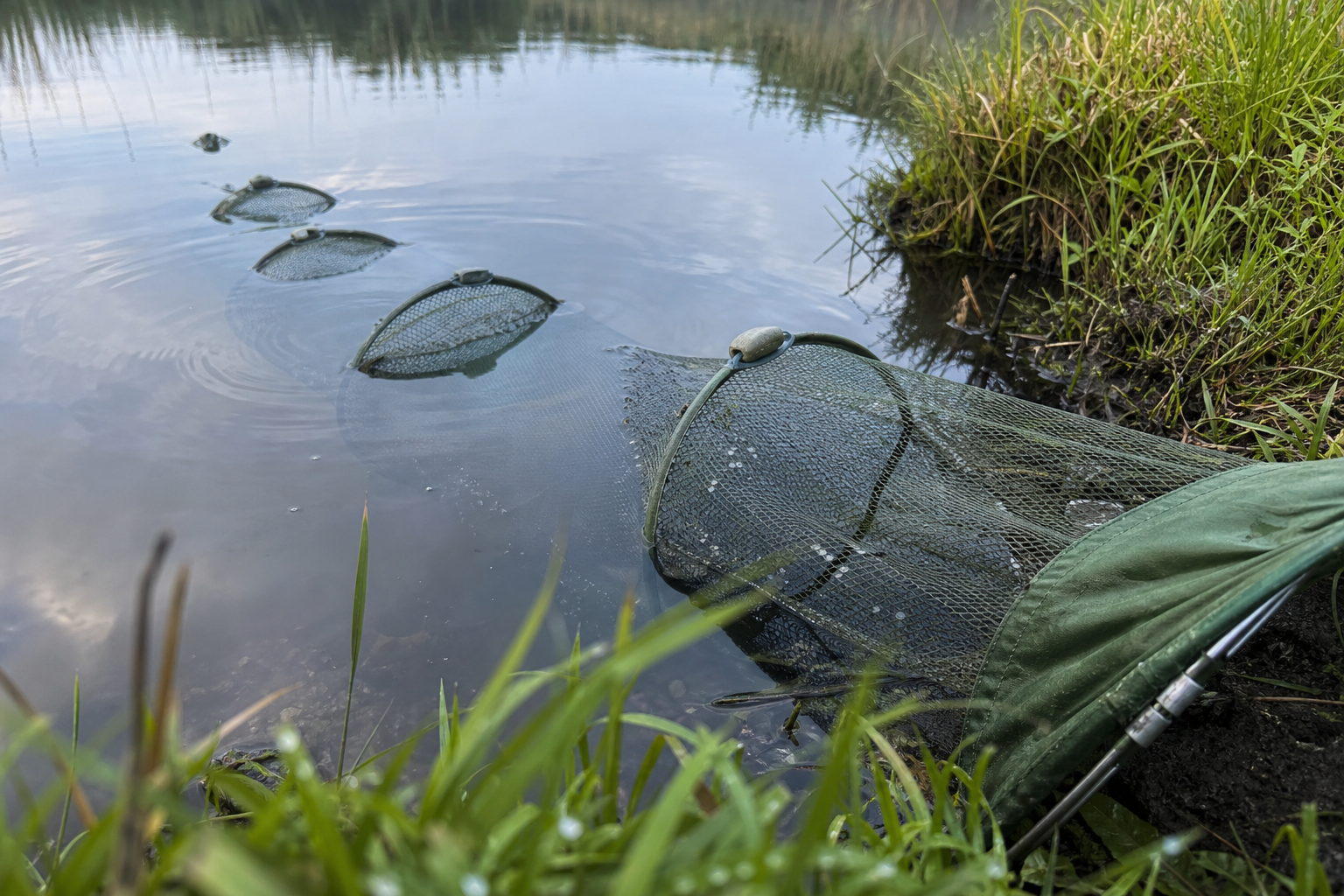
A keepnet is a long, tubular net fixed to the bank, sitting in the water, used to hold fish alive until they are released or weighed in at the end of a session. In coarse fishing, they are most commonly used during match or club sessions to retain small shoal fish such as roach, skimmers and small bream while the angler continues fishing.
That traditional match-fishing context is important to understand, because modern UK practice has moved significantly. Many fisheries now restrict or prohibit keepnet use for larger or more delicate species, and some waters ban them entirely on pleasure sessions. Species that should almost always be returned immediately include carp, barbel, pike, tench, zander, catfish and grayling. These fish are not suited to retention in a keepnet: they are stressed quickly by confinement, are more likely to suffer physical damage, and in many cases individual fishery rules explicitly exclude them.
Before you put a keepnet in the water at any session, there are three questions to answer.
Before you put the keepnet in
Ask yourself three things before every session. Does the fishery or club allow keepnets today? If so, for which species and sizes? And does your net meet the legal specification? If you cannot answer all three confidently, return fish straight away.
Keepnet Rules in England: What the Law Requires
The rules in this section come from the Environment Agency's national rod fishing byelaws, which apply in England only. They do not cover Wales, Scotland or Northern Ireland. If you are fishing in any of those nations, you must check with the relevant authority and your fishery before using a keepnet.
A byelaw is a legally binding rule set at a regional or national level, separate from primary legislation but enforceable in the same way. The Environment Agency's national byelaws set a minimum standard for keepnets used in England. Your net must meet all five requirements.
The table below sets out each requirement in plain language.
| Requirement | Minimum standard | What to check |
|---|---|---|
| Overall length | More than 2 metres | Measure the full length of the net, not just the bag |
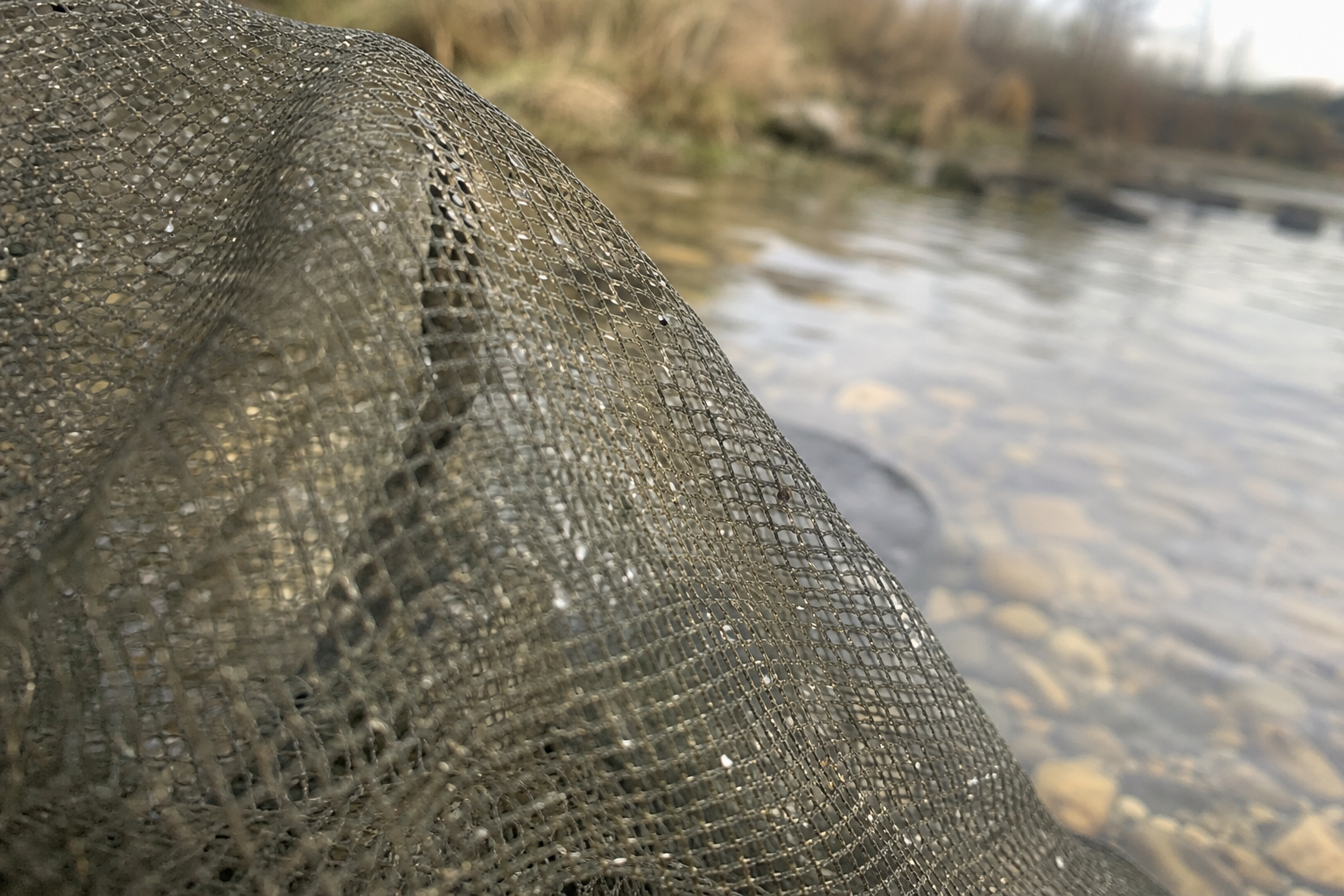
| Mesh type | No knotted mesh; no metallic mesh | Feel the knots — compliant mesh lies flat and soft |
| Mesh hole size | Smaller than 25 mm internal circumference | A matchstick should not pass through easily |
| Ring spacing | Supporting rings no more than 40 cm apart (excluding mouth to first ring) | Count the rings and measure the gaps |
| Ring circumference | At least 120 cm (roughly 38 cm diameter for circular rings) | Check the manufacturer's specification or measure yourself |
It is worth understanding why these numbers exist, not just what they are. The ban on knotted and metallic mesh protects fish from scale and fin damage; knotted mesh catches and tears. Small mesh holes prevent fins and tails from becoming trapped. Closely spaced rings keep the net open so fish are not cramped or squashed when numbers build up through a session. The minimum ring circumference ensures fish can hold their natural position in the water rather than being forced onto their sides.
Legal compliance is a baseline, not a ceiling. Many clubs and fisheries require longer nets or more stringent specifications than the byelaw minimum. Always check the rulebook for the water you are fishing before you set up.
Close Season and Regional Restrictions
Meeting the legal specification for the net itself is only part of the picture. Regional byelaws add further restrictions on when keepnets can be used, and these vary by water type.
On rivers and some canalised rivers in England that are subject to a statutory close season, keepnets may not be used during that close season period, which broadly runs from 15 March to 15 June. The close season is the period during which coarse fish on certain waters cannot legally be retained or disturbed in this way. You may be permitted to fish a water during this time in some circumstances, but not to use a keepnet. Check whether your river or venue is affected before the session.
There is also a firm national rule that applies throughout England regardless of season: it is illegal to retain salmonids in a keepnet. Salmonids are trout, salmon and their juveniles. This prohibition applies unless a specific activity has been approved by the Environment Agency. For the vast majority of coarse anglers, this means if a salmonid takes your bait, you unhook it and return it immediately.
Wales, Scotland and Northern Ireland
If you fish outside England, the Environment Agency's byelaws have no jurisdiction over you. Natural Resources Wales sets byelaws for Wales, and those rules differ from England's. Scotland and Northern Ireland each have entirely separate licensing and regulatory frameworks. The specification table and the rules described in this article apply in England only. If you are fishing elsewhere in the UK, contact the relevant authority and speak to your fishery before using a keepnet.
Keepnet Fish Care: Using a Keepnet Responsibly
A keepnet is a welfare responsibility, not a storage convenience. Used correctly and within the right rules, a keepnet allows a match angler to complete a session and weigh in fish that are then released in good condition. Used carelessly, it causes real harm: stress, scale loss, fin damage and, in serious cases, death.
The starting point for good keepnet fish care is choosing the right species to retain. Suitable fish are small shoal species: roach, skimmers, small bream and similar silverfish. These fish are robust enough to tolerate careful retention for the duration of a match session when conditions and equipment are right. The species that should be returned immediately are larger and more delicate: carp, barbel, pike, tench, zander, catfish and grayling. Some club rulebooks allow small carp in keepnets under authorised match rules with purpose-designed carp-safe nets, but if a rulebook does not explicitly state this, the fish goes back.
Overcrowding is one of the most common welfare failures. When too many fish are held in a single net, they jostle, lose scales and experience acute stress. Many clubs set a maximum weight limit per net, and some specify 30 to 40 lb as that limit. If you are approaching a club's stated limit, use a second keepnet rather than cramming more fish into the first.
Where you position the net matters as much as what goes in it. The net needs to sit in water of adequate depth; shallow, warm margins are unsuitable. The mouth should sit below the water surface so fish cannot escape or become injured at the lip of the net. Keep the net close to your fishing position so transfers from landing net to keepnet are short and calm.
Duration of retention should be as short as possible. Check the net periodically through the session. If any fish is showing signs of distress, rolling belly-up or labouring at the surface, release it straight away. At the end of the session, when you release fish, hold them upright in the water until they swim off strongly under their own power. Do not simply tip them in and walk away.
Net design contributes to welfare too. A drawstring or zip bottom makes releasing fish at the end of the session far less stressful than lifting the net and shaking them out. If you are buying a new net, look for one with a soft, flat-knit construction throughout.
If in doubt, return the fish
The safest choice is always immediate return. If conditions are hot, the water is shallow, you are unsure of the rules, or you are fishing for species that should not be in a keepnet, return each fish as you catch it.
How to Set Up and Use a Keepnet: A Step-by-Step Guide
The steps below take you through a keepnet session from start to finish. Following them in order will keep your fish in good condition and your technique within the rules.
Using a keepnet safely
Check permission and rules
Confirm the water allows keepnets on the day you are fishing. Ask about species restrictions, size limits and whether there is a close-season keepnet ban in place. If you are fishing a match, check the club rulebook before you leave home.
Inspect your net for legal compliance
Run through the five requirements: length over 2 metres, no knotted or metallic mesh, mesh holes under 25 mm internal circumference, rings at least 120 cm in circumference, rings no more than 40 cm apart. If your net does not meet any one of these requirements, it is not legal to use in England.
Choose the right species
Use the net only for small shoal fish such as roach, skimmers and small bream. Return carp and other large or delicate species immediately unless you are fishing an authorised match that explicitly permits their retention in a suitable net.
Position the net correctly
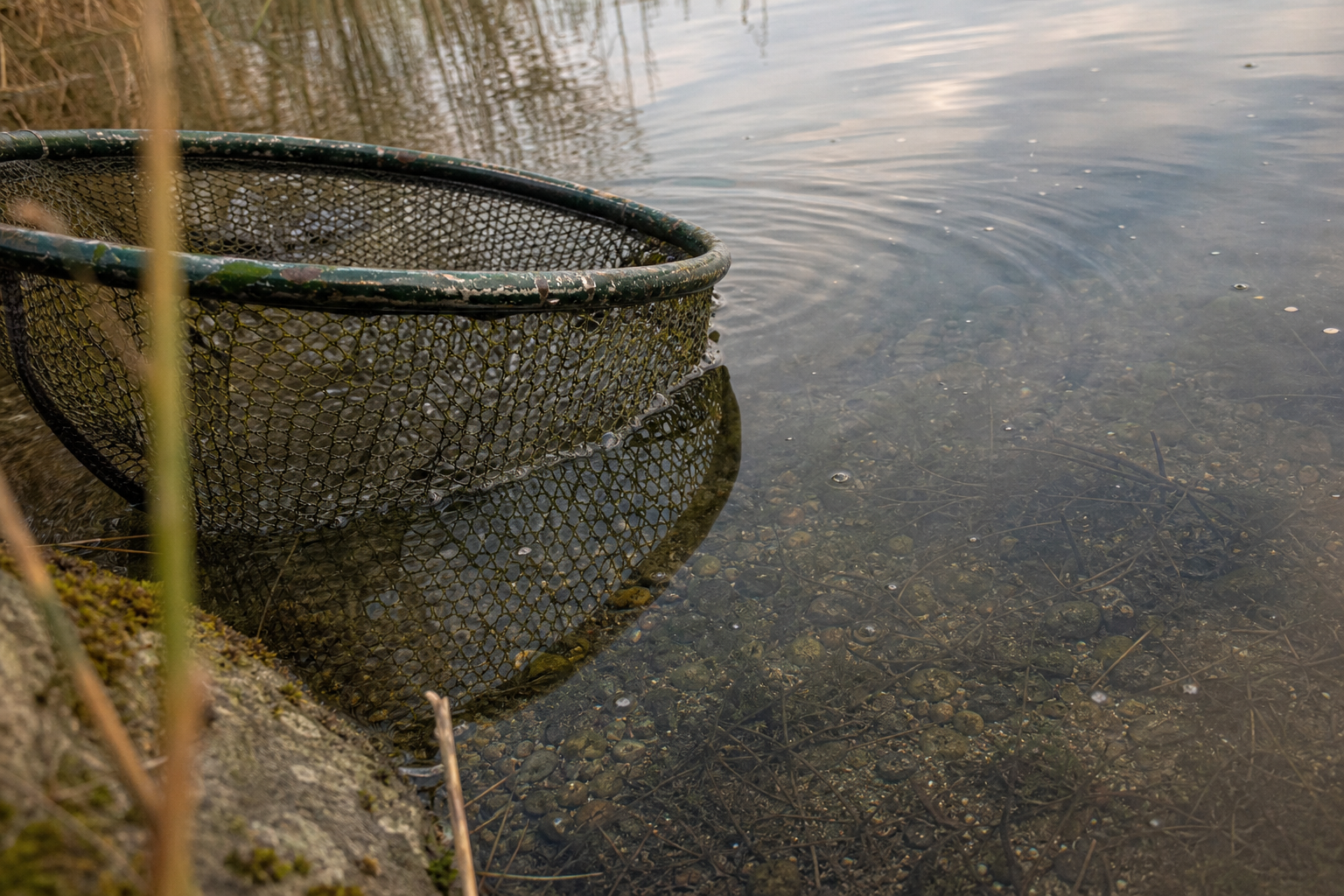
Fix the keepnet securely to a bank stick or platform so the mouth sits below the water surface and the full length lies in water of adequate depth. Keep it close to your fishing position so transfers are short.
Transfer fish gently
Land the fish in your landing net first. Keep the landing net over the water while you unhook. Slide the fish gently into the keepnet head-first. Never drop fish from height or throw them towards the net. The unhooking and fish handling techniques covered in the coarse fish care and fish handling gu
Monitor the net and manage numbers
Check the net regularly through the session. Release any fish showing signs of distress immediately. If you are approaching your club's weight limit, use a second net rather than cramming fish in.
Empty the net carefully
At the end of the session, lift the keepnet with the mouth staying underwater as long as possible. Use a drawstring or zip bottom to release fish gently. Never tip fish onto hard ground or a surface where they can flip and injure themselves.
Clean and dry the net
Rinse the net thoroughly after use and dry it completely before storing or moving it to another fishery. This is basic biosecurity practice and many clubs and fisheries require it. A wet net moved between waters can carry invasive species or disease.
Common Questions About Keepnets
Can I keep carp in a keepnet?
On most pleasure fisheries, no. The majority of commercial fisheries and coarse clubs either ban carp from keepnets entirely or permit them only under specific authorised match conditions with nets designed for the purpose. The reasoning is practical: carp are powerful fish that become stressed quickly in confinement, and they can cause real scale and fin damage both to themselves and to other fish in the net. If the rulebook for the water you are fishing does not explicitly state that carp may be retained in keepnets, return them immediately after landing.
Is my old keepnet still legal?
Check it against the five specification requirements listed in the table above. The age of the net or when you bought it is not relevant; what matters is whether it meets the current specification. Older nets are particularly likely to fail on mesh type, since knotted mesh was common in nets sold decades ago. If any one requirement is not met, the net is not legal to use in England.
Why are keepnets banned on some waters in spring?
Regional byelaws in England prohibit the use of keepnets on rivers and some canalised rivers during the coarse fish close season, which broadly covers 15 March to 15 June on affected waters. The close season exists to protect fish during spawning, and retaining fish during this period on these waters is not permitted even if fishing itself is allowed in limited circumstances. This is a common point of confusion: a water being open to fishing does not automatically mean keepnets are permitted there at that time.
Do keepnets harm fish?
Used correctly, with suitable species, a compliant net and a reasonable duration of retention, the welfare impact can be kept to a minimum. Used incorrectly, overcrowded, in warm shallow water, with unsuitable species, or with a net that does not meet the specification, a keepnet can cause serious harm. This is why many fisheries are restricting keepnet use on pleasure sessions, and why the decision to use one should always be an active choice rather than a default.
References and Further Reading
- Environment Agency, GOV.UK: National rod fishing byelaws for England, freshwater fishing with a rod and line.
- Environment Agency, GOV.UK: Freshwater rod fishing rules, tackle you can use.
- Environment Agency, GOV.UK: Rod fishing byelaws, North East region.
- Environment Agency, GOV.UK: Rod fishing byelaws, Midlands region.
- Canal & River Trust: Angling history, the keepnet.
Frequently asked questions
When can I use a keepnet at a fishery?
Only when the fishery or club permits keepnets on that day and for the species and sizes stated in its rules. Also check for any regional close season restrictions that may ban keepnets on certain waters.
What are the legal requirements for a keepnet in England?
It must be more than 2 metres long, have no knotted or metallic mesh, mesh holes smaller than 25 mm internal circumference, supporting rings no more than 40 cm apart, and rings with at least 120 cm circumference.
Can I keep carp in a keepnet?
On most pleasure fisheries, no. Carp are usually returned immediately unless an authorised match rule explicitly permits their retention with a purpose designed carp safe net.
How should I use a keepnet without harming fish?
Use it only for suitable small shoal species, ensure the mouth sits below the water surface in adequate depth, transfer fish gently head first from a landing net, avoid overcrowding, check fish regularly and release any in distress.
Do these England rules apply in Wales, Scotland or Northern Ireland?
No. The Environment Agency byelaws in the article apply only in England. If fishing elsewhere in the UK, check the relevant authority and the local fishery before using a keepnet.
Lake & Lines Editorial Team
Editorial team
The Lake & Lines editorial team brings together freshwater fishing guides and researched tackle advice, helping beginners and returning anglers prepare for better days by the water.